Why Most Investors Earn Less Than Their Mutual Funds

Your fund’s CAGR looks great on paper but how much of it did you actually pocket?

India’s mutual fund AUM crossed ₹66 lakh crore in 2025. Crores of investors track their returns with pride. Most are quietly earning far less than the fund delivered. Welcome to the Behaviour Gap.

The Gap Nobody Talks About

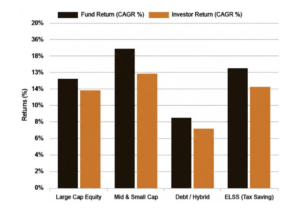
A fund’s “Total Return” (CAGR) shows what a lump sum would have grown to over time. However, Investor Return accounts for the timing of buys and sells.

  • The Reality: Globally, investors lose about 1–1.5% annually to poor timing.
  • The India Factor: In our volatile market, this gap is often much wider.
  • The Cause: We tend to pile into mid-cap rallies at the peak and panic-sell during corrections.

Why We Get in Our Own Way?

The culprit isn’t the market; it’s human psychology. Research shows a consistent, damaging pattern in Indian retail investing:

    • Performance Chasing: Inflows peak after a fund has already delivered massive 3-year returns.
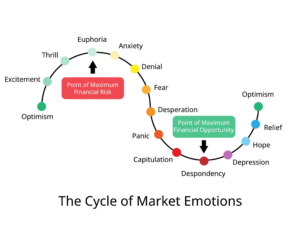
    • Panic Redemptions: Outflows spike precisely when NAVs bottom out.
    • The Result: By buying high and selling low, investors hand back their compounding gains to the market.

“We tend to buy after a fund has had a good run and sell after it’s had a poor run. Human nature, being what it is.” — Russel Kinnel, Morningstar Director of Manager Research

SIPs: The Tool vs. The Discipline

Systematic Investment Plans (SIPs) are the best defense against emotional trading, but they aren’t foolproof.

  • The Strength: Rupee-cost averaging automatically buys more units when prices are low.
  • The Weakness: The strategy only works if you don’t interfere.
  • The Common Mistake: Many investors pause SIPs during “bad” markets or switch to last year’s top performer, triggering exit loads and taxes.

How to Close the Gap

To ensure you actually “pocket” the CAGR your fund promises, follow these guidelines:

  1. Automate & Evacuate: Start a SIP and stop checking the NAV daily.
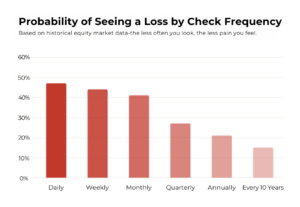
  2. The Quarterly Rule: Review your portfolio once every three months—never during a market crash.
  3. Kill the Comparison: Don’t swap funds just because another category had a temporary “hot” streak.
  4. Goal-Based Exit: Define your target date and let compounding work undisturbed until you reach it.

India’s new investors have something previous generations didn’t: awareness. The behaviour gap is not a market problem; it’s a mindset one. The fund will deliver its returns. The only question is whether you’ll be patient enough to receive them.

Frequently Asked Questions

  1. What is the “Behaviour Gap” in mutual funds?
    The difference between the returns a fund generates and the actual returns an investor “pockets.” It is usually caused by emotional decisions like buying when the market is high and selling during a crash.
  2. Why are my actual returns lower than the fund’s CAGR?
    If you started your investment after a fund already performed well, or if you paused your SIP during a market dip, you likely missed the periods of highest growth, leading to a gap in performance.
  3. Can an SIP completely eliminate the Behaviour Gap?
    An SIP is a powerful tool for discipline, but it only works if you don’t interfere. Investors often “break” the SIP by stopping it during volatility or switching funds frequently, which restores the gap.
  4. How often should I monitor my mutual fund portfolio?
    To avoid emotional triggers, it is best to review your portfolio quarterly or even bi-annually. Frequent daily checks of the NAV often lead to “panic-selling” or “performance chasing.”


Why Smart Money Prefers Indirect Investing?

In India’s Demat Revolution, retail participation is at record highs, with over 200 million demat accounts and monthly SIP inflows of ₹28,000 crore. Yet a divide remains. While many investors chase multibaggers through direct stocks, smart money like institutions and seasoned HNIs increasingly prefers indirect investing via mutual funds and index funds. Here is why this backseat approach may be the smarter choice for your portfolio:

  • The “Skill vs. Luck” Ratio 
      • Most retail investors treat direct stocks as a hit-or miss game. Smart money focuses on probabilities, using data and research teams that retail investors cannot match. 
        • The Data: A 2025 SEBI report showed that over 85% of retail direct stock portfolios failed to beat the Nifty 50 over three years. Over the last five years, the Nifty 50 delivered annualised returns of around 12–13%, while top Flexi cap funds generated average annualised returns of 16.08% during the same period.
        • The Strategy: Instead of spending hours on individual stocks, delegate to professionals. The goal is not to be right once, but to build consistent wealth over a decade. 

  • Diversification as a Survival Shield 
      • New investors often fall in love with themes like green energy or AI and over-concentrate. Smart money understands that sector leadership in India keeps rotating. 
        • The Data: In late 2025, some small-cap indices delivered negative returns due to valuation bubbles, while diversified equity funds stayed resilient by spreading across 50 to 70 companies. 
        • The Strategy: Use indirect investing for instant diversification. If one sector slows, growth in others like banking or consumption helps protect capital. 
  • Avoiding “Tax & Transaction” Leakage 
      • Direct trading is costly. Frequent portfolio churn to book short-term profits leads to losses from brokerage, STT, and 15% STCG tax. 
        • The Quantitative Fix: Active traders often lose 2% to 4% of their potential corpus annually to taxes and costs. In mutual funds, rebalancing happens without triggering taxes. You pay tax only when you withdraw years later
  • Overcoming the Emotional “Panic” Trigger 
    • Direct investing is highly emotional. A 7% single day fall often triggers impulsive selling. Indirect investing creates psychological distance that supports discipline. 
      • The Data: AMFI research shows SIP investors hold investments three times longer than direct equity traders. This discipline has pushed retail investors to a record 44% share of equity fund assets. 

The Strategy: Automate discipline by avoiding daily buy-sell decisions to protect long-term compounding.

Conclusion

The shift toward indirect investing is not a sign of giving up. It reflects maturity. Smart money understands that in a fast-moving and complex economy, consistency matters more than intensity. By choosing the indirect route, investors gain professional management, diversification, and tax efficiency. As India moves toward Capital Markets 3.0, winners will not be those who find the next big idea once, but those who stay invested in the entire growth story through a disciplined indirect approach.

Frequently Asked Questions

  1. What is indirect investing?
    Indirect investing means investing through mutual funds or index funds instead of buying individual stocks directly.
  2. Why do many experienced investors prefer indirect investing?
    Indirect investing provides professional management and diversification, which can help improve long-term returns and reduce risk.
  3. How does indirect investing help with diversification?
    Mutual funds and index funds invest in many companies across sectors, reducing the risk of losses from a single stock.
  4. Is indirect investing more tax-efficient than direct trading?
    Yes. Mutual funds allow portfolio rebalancing without immediate taxes, while frequent stock trading can trigger brokerage costs and short-term capital gains tax.


How Global Rate Cuts Are Shaping India’s Growth?

The Big Picture: RBI’s Strategic Moves

India’s central bank has been making headlines throughout 2025, and for good reason. In December, the Reserve Bank of India (RBI) announced its fourth rate cut of the year, reducing the repo rate by 25 basis points to 5.25%. This marks a cumulative reduction of 125 basis points since the beginning of the year, bringing borrowing costs to their lowest level since July 2022. 

What’s driving these cuts? The answer lies in cooling inflation and robust economic growth. With inflation dropping to just 0.25% in October 2025 and GDP expanding at a healthy 8.2%, RBI Governor Sanjay Malhotra has confidently signaled that rates could stay low for an extended period. The central bank has revised its FY26 inflation forecast down to just 2%, well below the 4% target, creating ample room for accommodative policy.

Global Context: The Fed’s Influence

India’s rate cuts didn’t happen in isolation. The US Federal Reserve has also been easing monetary policy, cutting rates three times in 2025 to bring the federal funds rate down to 3.5-3.75%. This global easing cycle has created a supportive environment for emerging markets like India. 

When the Fed cuts rates, foreign capital flows toward higher-return markets like India. This phenomenon, known as the “carry trade,” has resulted in significant Foreign Portfolio Investor (FPI) inflows in India exceeding ₹24,000 crore in recent months, particularly into banking, IT, and FMCG sectors.

Key Impact: Lower US rates weaken the dollar, potentially strengthening the rupee and making imports cheaper, especially crucial for India, which imports 85% of its crude oil requirements.

What It Means for You

Think of interest rate as the cost of money. Cutting it is like making loans cheaper – encouraging investment, borrowing and spending in discretionary sectors.

These rate cuts translate into real-world benefits for Indian consumers and businesses. Home loan EMIs are expected to decrease as banks pass on the benefits, making real estate more affordable. The automotive sector is already seeing increased demand with cheaper car loans, while businesses benefit from lower borrowing costs for expansion.

Stock markets have responded positively, with the Nifty 50 gaining 0.9% following rate announcements. Banking stocks, rate-sensitive sectors like real estate and automobiles, and export-oriented IT companies have been the biggest beneficiaries of this easing cycle. The returns on safer assets such as Government bonds would however, decrease.

Looking Ahead

The RBI has maintained a neutral policy stance, suggesting flexibility to adjust rates further if inflation remains subdued. With the next monetary policy meeting scheduled for February 2026, markets are watching closely for signals on the future trajectory of interest rates. 

As India positions itself as a key growth destination in an otherwise slowing global economy, these strategic rate cuts reflect a delicate balancing act supporting growth while keeping inflation anchored. For borrowers, investors, and businesses alike, 2025’s monetary easing has opened a window of opportunity that could extend well into 2026.

Frequently Asked Questions

  1. Why is the Reserve Bank of India (RBI) cutting rates?
    The RBI is cutting rates to support economic growth, as inflation has cooled to 0.25% and GDP is expanding at 8.2%. Lower rates help encourage borrowing, investment, and consumption.
  2. What’s the global context behind India’s rate cuts?
    The US Federal Reserve has also been cutting rates, which encourages foreign investment in emerging markets like India, boosting capital inflows and benefiting sectors like IT and banking.
  3. How do rate cuts impact the Indian economy?
    Rate cuts make borrowing cheaper, benefiting sectors like real estate, automotive, and banking. Consumers see lower home loan EMIs and car loans, while businesses enjoy lower expansion costs.
  4. How do lower US interest rates affect the Indian rupee?
    Lower US rates weaken the dollar, which could strengthen the rupee and make imports, particularly crude oil, cheaper—important for India’s economy as it imports most of its oil.


Is Your Portfolio Ready For The Risk Game? Let’s Find Out

Understanding Modern Portfolio Theory (MPT)

MPT, developed by Nobel laureate Harry Markowitz in 1952, transformed investing by showing that portfolio risk is determined not only by individual assets but also by how they move together. By combining assets that don’t move in lockstep, investors can reduce portfolio volatility without sacrificing returns. It’s similar to balancing ingredients in a recipe: the right mix of investments creates a smoother, more predictable outcome than any single ingredient alone.

The Efficient Frontier: Finding the Sweet Spot

A key concept in MPT is the “efficient frontier” – a curve showing the best possible portfolios that offer maximum expected return for each level of risk. Portfolios on this frontier provide the highest return for their risk or the lowest risk for their return. Portfolios below this frontier are suboptimal: you can achieve better returns without taking on more risk or reduce risk without sacrificing returns. Understanding your portfolio’s position relative to this frontier helps identify areas for optimization, helping maximise risk-adjusted returns for the investor.

Correlation: The Hidden Power

Correlation measures how assets move in relation to each other, ranging from +1 (moving together) to -1 (moving oppositely). It plays a pivotal role in determining portfolio diversification and asset allocation. Combining assets with low or negative correlation helps offset individual ups and downs, smoothing overall portfolio performance. For example, gold often shows low correlation with equities during market stress, while bonds behave differently than stocks. Real estate, international equities, and commodities each bring unique correlation characteristics. The key is systematically leveraging these relationships. Investing in two different assets which are highly positively correlated might not add diversification benefits to the portfolio.

Asset Allocation Drives Performance

Research shows that asset allocation, how you divide your portfolio among stocks, bonds, real estate, and other assets, explains 80-90% of portfolio return variability over time. Individual security selection plays a smaller role. MPT provides a framework for determining optimal asset allocation based on your specific risk tolerance and return requirements, using mathematical optimization rather than arbitrary decisions.

Risk-Adjusted Returns: The Real Metric

MPT introduces the Sharpe Ratio, a measure of excess return per unit of risk. A portfolio that returns 15% with high volatility might be less desirable than one returning 12% with lower volatility when risk is properly accounted for. Rather than chasing the highest returns, MPT emphasizes maximizing risk adjusted returns, getting paid appropriately for the risks taken. Sharpe Ratio depicts the returns earned for each unit of risk borne by the investor.

Mastering Portfolio Optimization

MPT demonstrates that diversification is not just conventional wisdom but a mathematical strategy. Risk and return must always be considered together. Portfolio construction combines systematic processes with human judgment in setting objectives. Whether you manage your own portfolio or work with an advisor, understanding MPT helps you ask better questions: Why this asset allocation? How does this investment affect portfolio correlation? What’s the expected risk-adjusted return?

Frequently Asked Questions

  1. What is Modern Portfolio Theory (MPT)?
    MPT, developed by Harry Markowitz in 1952, shows that portfolio risk is not only based on individual assets but also on how they move together. By combining assets with low correlation, investors can reduce risk without sacrificing returns.
  2. What is the Efficient Frontier?
    The Efficient Frontier represents the best portfolios that offer the highest return for each level of risk. Portfolios on this curve provide the best risk-return trade-off.
  3. Why is correlation important in portfolio management?
    Correlation measures how assets move in relation to each other. By combining assets with low or negative correlation, investors can reduce overall portfolio volatility and improve diversification.
  4. How does asset allocation affect portfolio performance?
    Asset allocation determines 80-90% of portfolio return variability. Proper allocation across different asset classes is critical for optimizing returns and managing risk, according to MPT.


Dollar’s Losing Streak: Can India Make A Big Play?

Understanding 2025’s currency shake-up and its impact on investors

The US dollar is experiencing its worst annual performance since 2017, plummeting nearly 10% against major currencies. For Indian investors and businesses, this global currency shift carries significant implications that extend far beyond Wall Street.

The Perfect Storm

Multiple factors triggered the dollar’s decline. Federal Reserve rate cuts, political uncertainty surrounding tariff policies, and concerns about US fiscal deficits combined to shake investor confidence. The unwinding of the dollar’s post pandemic strength accelerated as other central banks maintained higher rates, narrowing interest rate differentials. Markets began questioning America’s economic dominance, leading to a historic reallocation of global capital away from dollar denominated assets and toward emerging market currencies and alternative safe havens.

The Rupee Paradox

Ironically, while the dollar weakened globally, the Indian rupee faced its own challenges. The rupee depreciated over 6% in 2025, hitting record lows above ₹90 per dollar. Why? Foreign portfolio investors withdrew billions as US-India trade tensions escalated, and India’s trade deficit widened significantly. 

Silver Lining for India: A weaker rupee makes Indian exports more competitive globally. IT companies and pharmaceutical exporters are seeing improved margins as they earn dollars but spend in rupees. The Nifty IT index has surged 14% since September, directly benefiting from currency movements.

What Lies Ahead?

Analysts expect the dollar’s decline to continue into 2026 as interest rate differentials narrow globally. For Indian investors, this creates opportunities in export-oriented sectors while demanding caution around import-heavy industries facing higher costs. The Reserve Bank of India remains vigilant, using its substantial forex reserves to prevent disorderly currency movements while allowing market forces to operate. Hedging currency risk also becomes relevant to investors and businesses exposed, given the volatility.

As global currency dynamics reshape investment strategies, Indian markets stand at a crossroads balancing domestic challenges with unique export advantages in an evolving financial landscape.

Takeaways

Global USD trend and USD/INR trend don’t always move together. Indian investors need to monitor both the international USD trend and domestic INR factors such as capital flows, trade deficit, RBI policy to understand the net impact on investments.

Frequently Asked Questions

  1. Why is the US dollar performing poorly in 2025?
    The dollar’s decline is due to Federal Reserve rate cuts, political uncertainties, concerns about US fiscal deficits, and the global shift toward emerging market currencies.
  1. How does the weaker dollar affect Indian investors?
    A weaker dollar creates opportunities in export-oriented sectors like IT and pharmaceuticals, but it also increases costs for industries reliant on imports.
  1. Why did the Indian rupee depreciate despite the dollar’s decline?
    The rupee weakened due to foreign portfolio investor withdrawals, escalating US-India trade tensions, and a growing trade deficit.
  2. What are the benefits of a weaker rupee for India?
    A weaker rupee boosts Indian exports by making them more competitively priced. Sectors like IT and pharmaceuticals have seen improved margins as a result.


Is The Gold Rush Over, or Is There Still Time To Invest?

India’s precious metals market witnessed a spectacular 2025, with gold and silver delivering extraordinary returns that left traditional investments far behind. As we step into 2026, investors are asking: will this golden run continue?

The Remarkable 2025 Rally

The numbers tell an impressive story. Silver surged an astounding 165% on MCX, while gold climbed 81%, significantly outpacing the Nifty 50’s modest gains. This wasn’t just speculation, it was driven by fundamental forces reshaping global finance. 

What fueled this rally? Central banks, including the Reserve Bank of India, aggressively accumulated gold as a strategic reserve asset. Geopolitical tensions, weakening currency dynamics, and the Federal Reserve’s policy shifts created perfect conditions for precious metals to shine. Rising industrial demand and supply constraints of silver also favoured this run.

What Lies Ahead in 2026?

Analysts expect some consolidation after 2025’s dramatic gains, but the fundamentals remain strong. Gold could potentially reach ₹1,50,000 per 10 grams within the next 12-18 months, according to LKP Securities. Major banks forecast international prices touching $4,500-$5,000 per ounce. 

Silver Lining for India: Unlike gold, silver benefits from massive industrial demand, as solar panels, electric vehicles, and semiconductors all require silver. With supply deficits projected to widen to 280-300 million ounces in 2026, silver could deliver even stronger percentage gains than gold.

The Indian Context: Why It Matters

For Indian investors, the precious metals story has unique dimensions. India remains the world’s second-largest gold consumer, and cultural affinity for gold during festivals and weddings provides consistent domestic demand. The rupee’s trajectory against the dollar also plays a crucial role; any depreciation amplifies returns for Indian holders of dollar-denominated assets like gold and silver. 

Additionally, India’s ambitious renewable energy targets are driving silver demand domestically. The government’s push for solar installations and electric vehicle adoption means industrial silver consumption in India is set to grow exponentially, potentially tightening global supply chains further.

Smart Investment Approach

Given the current fundamentals, Indian investors should view any near-term volatility as accumulation opportunities rather than trend reversals. The combination of lower interest rates, sustained central bank buying, and industrial demand creates a supportive environment for both the metals. Whether through physical gold, ETFs, or sovereign gold bonds, precious metals deserve a strategic place in your 2026 portfolio.

Frequently Asked Questions

  1. What drove the gold and silver rally in 2025?hat is behavioral finance and why does it matter?
    Central banks bought gold as a reserve asset, and geopolitical tensions, currency dynamics, and Federal Reserve policy shifts boosted demand. Rising industrial demand for silver also contributed.
  1. Will the gold rush continue in 2026?
    While consolidation is expected, the fundamentals remain strong, with gold potentially reaching ₹1,50,000 per 10 grams and silver benefiting from growing industrial demand.
  1. What is the outlook for silver in 2026?
    Silver is expected to outperform gold due to high industrial demand and supply shortages, particularly in solar panels and electric vehicles.
  2. Why is India important for gold and silver markets?
    India is the second-largest gold consumer, and cultural demand remains strong. The rupee’s depreciation boosts returns on dollar-denominated assets like gold and silver.


The Hidden Psychology of Investing

Why Your Brain Might Be Your Biggest Investment Risk

You’ve done your research, analyzed the numbers, and tracked the trends. Yet when it’s time to make that crucial investment decision, something feels off. Maybe you’re holding onto a losing stock hoping it’ll bounce back, or buying into the latest market craze because everyone else is. Sound familiar?
Welcome to behavioral finance, where psychology meets money management, and understanding your own mind becomes just as important as understanding market trends.

The Psychology Behind Smart Investing

Traditional finance assumes investors are rational creatures, carefully weighing risks and rewards. But let’s be honest: that’s not how we actually operate. We feel fear when markets crash, excitement when stocks soar, and FOMO when friends brag about their wins.
Behavioral finance embraces this reality, exploring how emotions, mental shortcuts, and social influences shape our financial choices, often in ways we don’t realize.

The Four Biases Sabotaging Your Portfolio

Overconfidence Bias is that inner voice saying you’ve got it all figured out. A few winning trades, and suddenly you feel invincible, leading to aggressive trading and unnecessary risks. Markets are humbling teachers, and overconfidence usually precedes expensive lessons.

Loss Aversion explains why losing ₹10,000 feels far worse than gaining ₹10,000 feels good. This keeps investors trapped in bad positions, holding falling stocks because selling means admitting defeat. Meanwhile, that capital could be redirected to better opportunities.

Herd Behavior is the magnetic pull of the crowd. When everyone’s piling into a hyped IPO, it feels risky to stay on the sidelines. This social pressure drives investors to abandon their research and follow the masses—often right off a cliff.

Anchoring Bias fixates your mind on irrelevant reference points. That stock you bought at ₹1,000? Even as fundamentals deteriorate, you’re still waiting for it to return to your purchase price. The market doesn’t care what you paid, what matters is where the investment is headed.

Reshaping Investment Strategies

Understanding these biases is transforming how savvy investors approach their portfolios. By recognizing patterns like confirmation bias and herd mentality, investors can anticipate trends and manage risks more effectively. This integrated approach – combining quantitative data with psychological insights, leads to more disciplined strategies and consistent long-term performance.

The Mind Is the Market

The real differentiator in investing isn’t access to premium research—it’s the ability to manage emotions when information floods in. Recognizing your biases gives you a distinct advantage. While others panic-sell during corrections, you maintain perspective. When the crowd rushes toward the next shiny object, you evaluate objectively.
Mastering behavioral finance ultimately means mastering yourself: building discipline to stick with your plan when it’s uncomfortable, wisdom to admit when you’re wrong, and emotional fortitude to stay invested in your long-term vision. In the world of investing, that self-mastery is where lasting success truly begins.

Frequently Asked Questions

  1. What is behavioral finance and why does it matter?
    Behavioral finance studies how emotions and biases impact investment decisions, highlighting mistakes driven by fear, overconfidence, and social pressures.
  1. What are the most common investor biases?
    Common biases include overconfidence, loss aversion, herd behavior, and anchoring bias, which lead to poor decision-making.
  1. How can understanding behavioral finance improve investment returns
    Awareness of biases helps avoid emotional decisions, enabling disciplined strategies and long-term consistency.
  2. Why is behavioral finance especially important for Indian investors?
    With rising digital investments in India, behavioral finance helps new investors avoid emotional traps and supports sustainable wealth building.


The Commodity Curveball

Understanding How Geopolitics Drives Price Volatility

In 2025, geopolitical tensions have become the dominant force behind the heightened volatility and price fluctuations across global commodity markets. What was once a secondary concern, political conflicts, trade disputes, and evolving policies now play a central role in shaping the dynamics of energy, metals, and agricultural sectors. These geopolitical shifts create immediate ripples throughout supply chains, significantly influencing investor sentiment and making commodity markets increasingly attuned to global political events.

Strategic Impacts on Commodities

The energy sector remains highly susceptible, with regional conflicts and supply disruptions driving prices higher, stoking global inflation fears. Trade tensions, especially between the U.S. and China, exacerbate the volatility in metals and agricultural markets through tariffs and sanctions, further increasing costs and uncertainty.

Agricultural commodities face a compounded challenge, where geopolitical instability intersects with climate-related shocks, intensifying supply concerns and sparking global food security debates. Simultaneously, evolving climate policies are reshaping demand for both traditional and renewable energy commodities, adding further complexity to an already turbulent market.

Safe Havens in Turbulent Times

Amidst growing geopolitical risks and inflationary pressures, gold and silver have emerged as dependable safe havens. By the end of October 2025, gold had surged nearly 47% year-to-date, nearing $3,996 an ounce. Silver saw an even stronger performance, rising approximately 60% to trade around $46-$47 an ounce, driven by robust investment demand and its increasing use in green technologies.

Navigating Market Volatility: The Investor’s Guide

For investors and corporate players, the key takeaway is the imperative need for agility and effective risk management. Diversifying supply chains, employing advanced hedging strategies, and leveraging real-time market analytics have become essential tools in navigating this volatile landscape. Given the heightened sensitivity of commodity markets to geopolitical shocks and monetary policy shifts, the ability to anticipate and adapt quickly will be the defining factor for success in 2025 and beyond.

Frequently Asked Questions

  1. How do geopolitical tensions affect commodity markets?

Geopolitical tensions cause supply disruptions and change investor sentiment, leading to price fluctuations in energy, metals, and agriculture.

  1. Why is the energy sector vulnerable to geopolitical events?

Energy prices are sensitive to conflicts and supply disruptions, causing sudden price hikes and contributing to global inflation.

  1. How have gold and silver performed amid geopolitical instability?

Gold and silver have surged in value, with gold rising 47% and silver 60% in 2025, driven by investor demand and silver’s use in green tech.

How Time Beats Volatility in the Stock Market

How Time Beats Volatility in the Stock Market

Investing in the stock market is often perceived as a roller-coaster ride of unpredictable highs and lows. However, time has proven to be a powerful ally in mitigating the effects of market volatility. In this article, we’ll delve into how time beats volatility in the stock market, why long-term investing is a winning strategy, and how you can leverage time to sustain wealth.

Understanding Market Volatility

Market volatility refers to the rapid and unpredictable fluctuations in stock prices. While it can be daunting for short-term traders, long-term investors can use volatility to their advantage. Instead of reacting to market dips and peaks, seasoned investors adopt a long-term perspective, allowing them to ride out market cycles and reap significant returns.

Key Takeaway: Volatility is a natural part of the stock market. It is not something to fear but rather a phenomenon to understand and manage effectively.

The Power of Time in Investing

Time is the most critical factor in mitigating volatility. Here’s how:

1. Compounding Effect: The longer you stay invested, the more time your investments have to grow through compounding. Compounding generates returns on both your initial investment and the accumulated returns, creating exponential growth over time.

Example: If you invest ₹1,00,000 at an annual return of 10%, your investment will grow to approximately ₹2,59,000 in 10 years and over ₹6,72,000 in 20 years. The longer you remain invested, the greater the impact of compounding.

2. Market Cycles Even Out: Over the short term, the stock market can be highly volatile, reacting to economic news, geopolitical events, and investor sentiment. However, over the long term, these fluctuations tend to average out.

Historical data shows that despite periodic crashes, the market has always trended upwards in the long run. For instance, the BSE Sensex, which was around 100 points in 1979, crossed 66,000 points in 2023.

3. Cost Averaging: Regular investments through methods like SIP (Systematic Investment Plan) allow investors to average the cost of their investments. When the market is down, you buy more units; when the market is up, you buy fewer units. This strategy reduces the impact of short-term volatility.

Why Short-Term Trading is Risky

Short-term trading involves buying and selling stocks based on market movements. While some traders may make quick profits, the majority end up losing money due to:

  • Emotional Decision-Making: Fear and greed often drive short-term traders, leading to irrational decisions.
  • Transaction Costs: Frequent buying and selling can rack up significant brokerage fees and taxes, reducing overall returns.
  • Market Timing Risks: Predicting market movements accurately is nearly impossible, even for experienced investors.

Case Study: The 2008 Financial Crisis

The 2008 financial crisis is a prime example of how long-term investing can outlast short-term volatility. During the crisis, the stock market plummeted by nearly 50%, and investors who panicked and sold off their assets incurred massive losses.

However, those who remained invested and continued to contribute to their portfolios saw their investments recover and grow significantly over the next decade. By 2021, the market had not only recovered but also reached record highs.

Lesson: Staying invested during volatile periods can yield substantial long-term gains.

Strategies to Leverage Time in the Stock Market


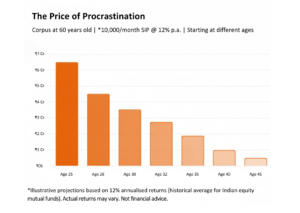
  1. Start Early: The earlier you start investing, the more time your investments have to compound. Even small investments can grow significantly over 15-20 years.
  2. Diversify Your Portfolio: A well-diversified portfolio reduces risk and smoothens returns over time. Include a mix of large-cap, mid-cap, and small-cap stocks, along with bonds and mutual funds.
  3. Invest Consistently: Regular investments, such as monthly SIP, help in rupee cost averaging and mitigate the impact of short-term volatility.
  4. Focus on Quality Stocks: Invest in fundamentally strong companies with a history of consistent earnings, robust management, and sustainable growth.
  5. Stay Disciplined: Avoid reacting to short-term market noise. Stick to your investment plan and review your portfolio periodically, but avoid impulsive decisions based on market fluctuations.

How to Stay Calm During Volatile Markets

  • Stay Informed but Not Obsessed: Keep track of market news but avoid checking your portfolio daily.
  • Revisit Your Financial Goals: Remind yourself why you started investing — long-term wealth creation, retirement planning, or financial independence.
  • Seek Professional Guidance: Consult a financial advisor to help you maintain a steady investment strategy during market turmoil.

Conclusion

Time is the ultimate weapon against market volatility. While short-term market movements may be unpredictable, the long-term trend of the stock market has historically been upward. By focusing on compounding, cost averaging, and disciplined investing, you can navigate market volatility with confidence and build wealth sustainably.

Are you ready to harness the power of time to beat volatility and achieve your financial goals? Start investing today and let time work its magic.

Frequently Asked Questions

  1. How does time help in reducing the impact of stock market volatility?

Time allows investments to recover from short-term market fluctuations. Over the long term, the stock market has historically trended upward, averaging out periods of volatility and generating positive returns.

  1. What is compounding, and how does it work in long-term investing?

Compounding is the process where your investment earns returns, and those returns generate additional returns over time. The longer you stay invested, the more powerful the compounding effect becomes.

  1. Can short-term trading beat the market?

Short-term trading is risky and requires precise market timing, which is extremely difficult. Long-term investing is more likely to yield consistent returns by mitigating short-term volatility and leveraging compounding.

  1. What is rupee cost averaging, and how does it help in volatile markets?

Rupee cost averaging involves investing a fixed amount at regular intervals. During market dips, you buy more units; during market highs, you buy fewer units. This strategy helps in averaging out the cost of investments over time.

Saving vs. Investing: What’s the Difference and Why It Matters

When it comes to managing your money, you’ve probably heard a lot about saving and investing. But what exactly do these terms mean, and why are they so important for your financial future? Let’s break it down in simple terms.

What is saving?

Saving is the process of setting aside money for future use. It involves putting money in a safe place where it’s easily accessible, like a savings account or a fixed deposit. This money is usually kept for emergencies, short-term goals, or planned future expenses.

How do you save?

Saving involves regularly depositing a portion of your income into a savings account or other low-risk financial instruments. Automating these transfers can help make saving a consistent habit. Many banks and financial institutions offer automatic transfer services where a predetermined amount of money is moved from your checking account to your savings account at regular intervals.

Why should you save?

Saving ensures you have funds available for emergencies, planned expenses, or short-term goals. It provides financial security and peace of mind, knowing that you have money set aside for unexpected events or specific future needs.

Benefits of saving:

1. Financial Safety Net: Having savings provides a cushion for emergencies. If unexpected expenses arise, such as medical bills or car repairs, your savings can cover these costs without disrupting your regular budget.


2. Liquidity: Savings accounts ensure that you have easy access to your money whenever you need it. This liquidity is crucial for handling short-term financial needs and emergencies.


3. Low Risk: Savings accounts are generally safe and stable. Your money is secure, and there is little to no risk of losing it.

Drawbacks of saving:

1. Lower Returns: Savings accounts typically offer lower interest rates compared to investments. While your money is safe, it doesn’t grow as quickly as it could in higher-risk investments.        


2. Inflation Risk: Over time, inflation can erode the purchasing power of your savings. If the interest earned on your savings doesn’t keep up with inflation, the real value of your money decreases.

What is investing?

Investing involves putting your money into assets like stocks, bonds, mutual funds, or real estate to grow your wealth over time. Unlike saving, investing carries a certain level of risk, but it also offers the potential for higher returns.

How do you invest?

Investing requires researching different investment options, diversifying your portfolio to manage risk, and regularly contributing to your investments.


Here’s a step-by-step guide on how to start investing:


1. Set Clear Goals: Determine what you want to achieve with your investments. Are you saving for retirement, a down payment on a house, or your child’s education?


2. Create a Budget: Assess your financial situation and determine how much money you can afford to invest regularly.


3. Educate Yourself: Learn about different types of investments and how they work. Books, online courses, and financial advisors can provide valuable insights.


4. Choose Investment Accounts: Open the necessary accounts, such as brokerage accounts or retirement accounts (like a PPF or NPS in India).


5. Diversify Your Portfolio: Spread your investments across different asset classes to reduce risk. A diversified portfolio might include stocks, bonds, mutual funds, and real estate.


6. Start Small: Begin with small investments and gradually increase the amount as you become more comfortable.


7. Monitor and Adjust: Regularly review your investments and make adjustments as needed to stay aligned with your goals.

Why should you invest?

Investing helps grow your wealth and achieve long-term financial goals. While saving is important for short-term needs and emergencies, investing is crucial for building wealth over time and achieving larger financial objectives such as retirement, buying a home, or funding education.

Benefits of investing:

1. Higher Returns: Investments typically offer higher returns compared to savings accounts. Over the long term, the stock market and other investments have historically provided significant growth.


2. Wealth Building: Investing helps you accumulate wealth over time. Through the power of compound interest, your investments can grow exponentially.


3. Achievement of Long-Term Goals: Investing is essential for reaching long-term financial goals. Whether it’s retirement, buying a house, or funding education, investments provide the necessary growth to meet these objectives.


4. Inflation Hedge: Investments, particularly in assets like stocks and real estate, tend to outpace inflation, preserving the purchasing power of your money.

Drawbacks of investing:

1. Higher Risk: Investments carry the risk of losing money, especially in the short term. Market fluctuations can lead to temporary losses, which might be concerning if you need to withdraw your funds quickly.


2. Volatility: The value of investments can fluctuate widely due to market conditions. This volatility requires a long-term perspective and the ability to withstand short-term losses.


3. Complexity: Investing can be complex and requires a good understanding of financial markets. Making informed decisions often involves continuous learning and staying updated with market trends.


4. Time-Consuming: Managing investments can be time-consuming, especially if you’re actively trading or closely monitoring your portfolio. It often requires regular review and adjustments.

Conclusion

Understanding the differences, benefits, and drawbacks of saving and investing is crucial for creating a balanced financial plan. Savings provide the security and liquidity needed for short-term needs and emergencies, while investments offer the growth potential necessary for achieving long-term financial goals.


By balancing both saving and investing, you can secure your present and build a prosperous future. Start with saving to establish financial security, then invest to grow your wealth and achieve your financial dreams.