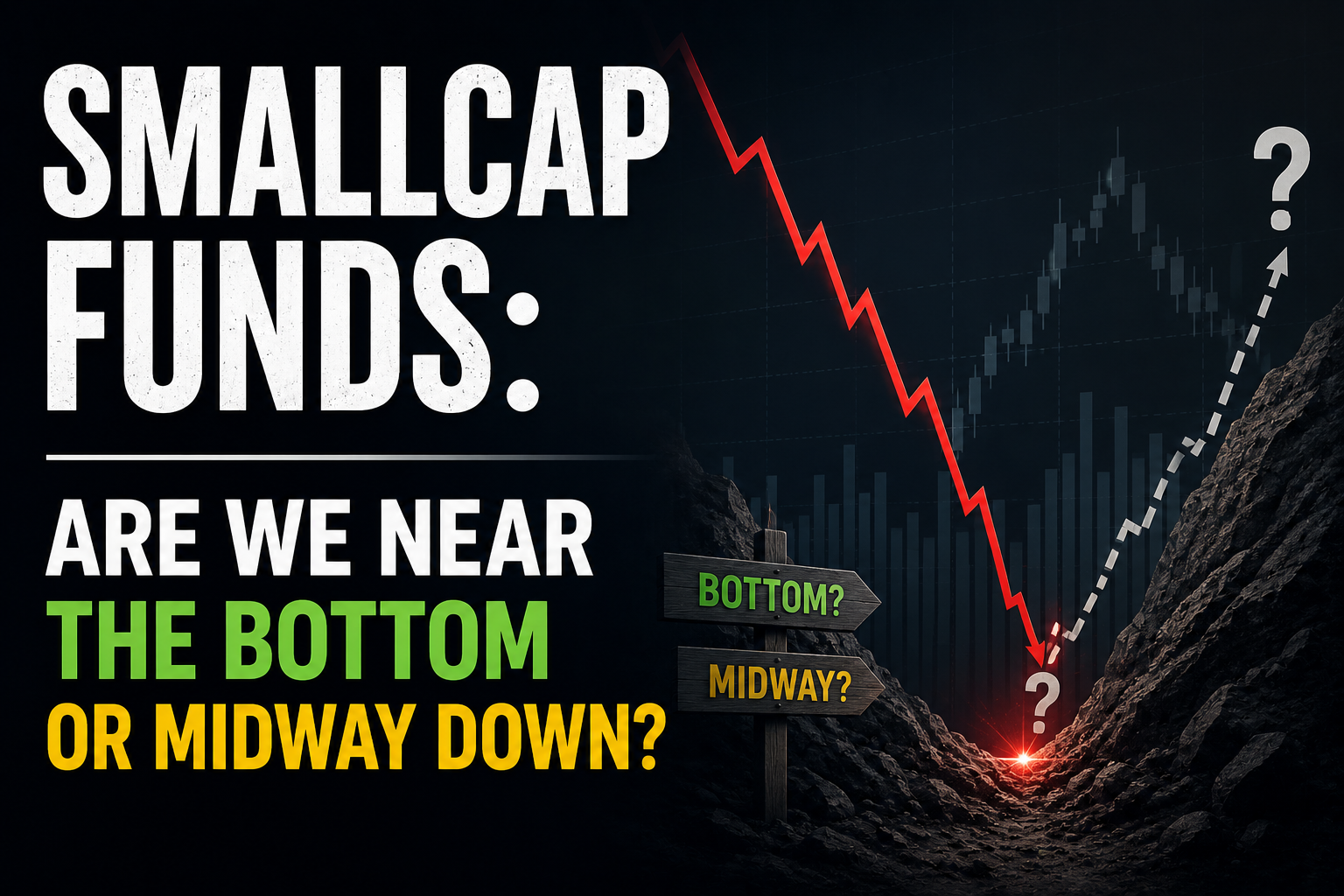
SmallCap Funds: Are We Near the Bottom or Midway Down?

Small-cap funds usually rise much faster in highly optimistic markets, but they can also fall significantly harder when market sentiment turns weak. During deep market corrections, fear often spreads much faster than facts. This makes it incredibly difficult for retail investors to judge whether prices are finally nearing a bottom or whether the overall decline still has more room to continue.

Why Small caps Correct More Sharply?

Smallcap funds react strongly and rapidly when market confidence begins to weaken. This high vulnerability is driven by three clear structural factors:

  • Lower Liquidity: Because smallcap stocks have much lower daily trading volumes, sudden selling pressure affects their market prices far more quickly than large-caps.
  • Higher Valuation Risk: Smallcaps frequently trade at expensive multiples during bull runs; these stocks correct much faster when future expectations inevitably reset.
  • Sentiment Sensitivity: The smallcap segment relies heavily on overall market risk appetite rather than deep institutional backing, making it highly reactive to negative headlines.

How to Read the Current Fall

A major correction in smallcap funds should never be judged solely by the absolute percentage decline of the index. To understand the depth of the fall, consider these underlying realities:

  • The Valuation Reset: Rapidly rising prices earlier may have pushed valuations well above fundamental comfort levels. A fall can actually be healthy if it effectively removes this excess optimism.
  • The Earnings Anchor: If fundamental company earnings hold strong, the dip presents a viable opportunity. But if company earnings begin to weaken too, the downward correction is highly likely to continue.

In simple terms: The real question is not just how much prices have fallen, but how much structural value remains.

Beyond Prices: What Else Should We Watch?

Finding the true floor of a smallcap correction depends on macro metrics rather than basic index charts. Investors must focus on:

  1. Earnings Growth: Sustained, real profit growth is the only absolute support that can trigger a long-term price recovery.
  2. Liquidity Conditions: Thin market liquidity can dramatically worsen price declines, creating a wider gap between paper valuations and execution realities.

What Needs Attention Right Now?

Even when smallcap fund NAVs look significantly cheaper, maintaining absolute discipline remains critical. You must watch out for these common psychological traps:

  • The Bottom-Fishing Trap: Catching a falling knife by entering immediately after sharp falls does not guarantee you are buying anywhere near the actual bottom.
  • The Fake Rebound: Short-term, aggressive rebounds are very often temporary “relief rallies” or dead-cat bounces rather than a structural reversal.
  • Prolonged Weakness: Broad, segment-wide weakness in smallcaps can easily last much longer than retail investors expect.

The Bigger Picture

Smallcap corrections typically move in distinct phases, which explains why a market can appear deceptively cheap after an initial fall yet still remain vulnerable to further drawdowns.

A price drop alone never confirms a definitive bottom. The real signal comes only from a structural mix of reasonable valuations, underlying earnings resilience, and localized liquidity conditions. Instead of trying to predict the exact turning point, your focus should be on whether the core risks are now fully understood and fairly priced in.

Frequently Asked Questions

  1. Why do smallcap funds experience much deeper drops than large-cap funds?
    Smallcap stocks have low daily trading liquidity. When panic hits and investors try to sell all at once, the lack of ready buyers forces stock prices down at an accelerated rate compared to highly liquid blue-chip companies.
  2. Is a 20% drop in a smallcap fund a reliable signal that it has reached the bottom?
    No. Percentage drops alone are deceptive. If a smallcap fund was trading at highly overvalued levels before the correction, a 20% drop might simply mean it is midway down, especially if corporate earnings are also slowing down.
  3. Should I stop my smallcap SIP during a deep segment correction?
    No. Stopping your SIP during a correction defeats the purpose of the strategy. Dips allow your automated monthly investments to accumulate a higher volume of mutual fund units at significantly lower costs, boosting your long-term compounding base.
  4. What should an investor focus on instead of predicting the market bottom?
    Investors should evaluate structural business fundamentals, diversification, and time horizons. The goal is to ensure your portfolio can comfortably withstand extended phases of stagnation without forcing you to sell out in panic.

Beyond the Paper Value: Understanding Mutual Fund Liquidity

A mutual fund’s Net Asset Value (NAV) shows the reported value of its underlying holdings. But in a full-blown market crisis, that on-paper value may not completely match what investors actually receive upon exit. If too many investors rush to exit at the exact same time, a fund may be forced to sell off its underlying assets quickly, often at much weaker prices.

Why Liquidity Matters for Funds?

Liquidity risk stays completely hidden in normal, rising markets. Because the daily NAV looks highly precise, it naturally feels reliable. However, liquidity affects mutual funds in several deep ways that shape the real strength of a fund during intense market panic:

  • NAV vs. Exit Value: The reported, end-of-day value of an asset may differ significantly from its real, real-time sale value under stress.
  • Forced Selling: Heavy redemptions can push fund managers to sell off their most liquid stocks or papers under severe time pressure.
  • Price Impact: Less liquid underlying holdings have a harder time finding buyers, causing their prices to fall much faster during market stress.

In short, the real test of a fund’s asset framework comes only when a large crowd of investors attempts to redeem their units together.

Not All Sectors React the Same Way

Liquidity stress does not impact the market uniformly; it affects different mutual fund categories based on the depth of their underlying holdings:

  • Small & Midcap Funds: Lower daily trading volume and market depth can dramatically widen exit pressure when a fund tries to liquidate massive positions.
  • Debt Funds: Lower-rated corporate papers or illiquid credit structures may become nearly impossible to sell smoothly during a credit freeze.
  • Concentrated Funds: Having fewer overall holdings in the portfolio can heavily increase the individual liquidity risk of each asset.
  • Sector/Thematic Funds: A narrow investment exposure to just one pocket of the economy can amplify localized selling pressure.

The Hidden Exit Problem

When a panic-driven crisis exit occurs, it exposes a sharp gap between a fund’s theoretical paper value and its real-world liquidation value:

  1. Fire-Sale Risk: To meet sudden, heavy withdrawal demands, assets may have to be dumped below their actual fair values.
  2. Cash Pressure: Funds are forced to pile up lower-yielding cash or liquid buffers for withdrawals, which can drag down overall performance.
  3. Investor Impact: The structural stress is unevenly shared; remaining long-term investors may bear the ultimate cost of a degraded portfolio left behind after a mass exit.

What Needs Attention?

To protect your wealth during high-redemption phases, your focus should move entirely beyond past returns and past ratings toward actual exit strength. Investors need to monitor three core metrics:

  • Portfolio Liquidity: How easily and quickly can the fund’s underlying holdings be converted to cash without crashing the price?
  • Concentration Risk: Narrow portfolios with oversized single-stock exposure may face much sharper price pressure during sell-offs.
  • Redemption Trends: Sustained, heavy exits across an entire fund category can structurally weaken the fund’s overall stability.

The Bottom Line

An NAV is a useful benchmark, but it is not a bulletproof guarantee of a smooth, friction-free exit. It strictly reflects reported value, not crisis value. In good market conditions, returns attract all the attention; but in stressed market conditions, liquidity becomes your only real protection.

Frequently Asked Questions

  1. What exactly is liquidity risk in a mutual fund?
    It is the risk that a fund manager cannot sell the fund’s underlying stocks or bonds quickly enough to pay back redeeming investors without taking a massive hit on the asset’s price.
  2. How does a mass redemption hurt the investors who stay in the fund?
    To pay exiting investors quickly, fund managers often sell their best, most liquid stocks first. This can leave remaining long-term investors holding a portfolio filled with less liquid, higher-risk, or underperforming assets.
  3. What is “Fire-Sale Risk” in mutual fund terms?
    Fire-sale risk occurs when a fund is hit with an overwhelming wave of cash withdrawals and is forced to sell off its holdings immediately at steep, discounted market rates just to raise cash.
  4. How do debt funds handle extreme liquidity stress?
    Debt funds holding high-quality government securities or AAA-rated papers can sell them instantly. However, funds holding lower-rated corporate papers face severe stress because those papers often completely stop trading during a credit panic.

Trade Wars & Silver Linings: Why India Is the New Alternative

The US tariff shock has created uncertainty across global trade. For India, the immediate concern is clear: higher duties can make exports costlier and hurt price-sensitive sectors. But every trade disruption also forces global buyers to rethink where they source from.

The real question is not whether tariffs are good or bad. The question is whether India can use this moment to become a more reliable alternative in global supply chains.

What’s Creating the Opportunity for India?

The opportunity is not automatic. It comes from a fundamental shift in how global companies are thinking about manufacturing and risk:

  • China+1 Strategy: Many global companies want to reduce overdependence on China. India can benefit if it offers scale, stability, and better delivery reliability.
  • Export Diversification: Indian sectors such as textiles, engineering goods, electronics, chemicals, pharmaceuticals, and auto components can attract more attention from US buyers.
  • Manufacturing Push: With PLI schemes, Make in India, and improving infrastructure, India is trying to move from being a consumption market to a stronger production base.
  • US Market Access: The US remains a key Indian export market. Sourcing shifts there offer meaningful opportunities for Indian firms. USTR data shows US goods imports from India hit $103.8 billion in 2025.

The Trade War: Short-Term Shock or Long-Term Shift?

Tariffs create short-term pressure because exporters may face lower margins, delayed orders, or renegotiated contracts.

Beyond the immediate noise, trade wars often change buying behavior. Companies start asking a bigger question: “Can we depend on one country for everything?” That is where India’s long-term opportunity lies. If India can improve quality, logistics, delivery timelines, and compliance standards, this disruption can turn into a structural export advantage.

“The investor of today does not profit from yesterday’s growth. He profits by seeing tomorrow’s opportunity before the crowd does.” — Warren Buffett

Tariff Risks: Is India Fully Safe?

India benefits from and is exposed to the trade war. US tariffs on Indian goods reportedly dropped from 50% to 18%, yet policy uncertainty persists.

Sectors like textiles, gems, and chemicals depend heavily on final tariff treatment and competitiveness. The opportunity exists, but execution will determine the eventual winners. Strategic agility remains the primary safeguard against fluctuating global trade dynamics.

The Bottom Line

US tariffs are not just a trade problem; they are also a total supply-chain reset.

  • Short term: Indian exporters may face pricing pressure, margin stress, and order uncertainty.
  • Long term: India can gain significantly if it becomes a dependable manufacturing and export hub.

For investors and businesses, the key is to separate temporary tariff excitement from companies with real export strength, scale, quality, and execution. Trade wars reward only the prepared. India has the opening, but true advantage requires converting global uncertainty into dependable supply, superior quality, and stronger execution.

Frequently Asked Questions

  1. What is the China+1 strategy and how does it help India?
    It is a global business strategy where companies diversify their manufacturing outside of China to reduce supply chain risks. India stands to benefit by positioning itself as the primary alternative with its large scale and labor pool.
  2. Why do US tariffs cause short-term shocks to Indian exporters?
    Tariffs instantly make goods more expensive for US importers. This forces Indian exporters to either absorb the cost by cutting their profit margins or face lower order volumes and renegotiated contracts.
  3. What role do PLI schemes play in global trade wars?
    Production Linked Incentive (PLI) schemes lower production costs and improve infrastructure for domestic manufacturers. This helps Indian businesses maintain competitive pricing even when foreign tariffs increase.
  4. Why did tariffs on Indian goods drop from 50% to 18%?
    The drop reflects a shift in bilateral trade deal negotiations and policy adjustments. However, because this rate can fluctuate based on global trade dynamics, long-term policy uncertainty still remains a risk.

The Hidden Impact of High Interest Rates on Equity Valuations

Interest rates are one of the most powerful forces in financial markets. When central banks raise rates, the immediate focus is often on borrowing costs, but the deeper impact is on how equities are valued. As rates rise, the fundamental way investors look at future earnings begins to change.

Why Interest Rates Matter for Stocks

Higher interest rates affect equities through multiple channels, directly influencing how investors assess company performance and growth potential:

  • Cost of Borrowing Increases: Companies face higher interest expenses on their loans, which can directly eat into their net profitability.
  • Lower Consumer Spending: When loans for cars, homes, and credit cards become expensive, consumers spend less, affecting overall company revenues.
  • Shift in Investment Preference: As yields on “safe” fixed-income instruments (like FDs or Bonds) rise, they become more attractive compared to the riskier equity market.

How Valuations Get Impacted

The effect of rising rates is most visible in valuation multiples. It all comes down to the math of “Discounted Cash Flows”:

  • Present Value Compression: Future earnings are discounted at higher rates, which reduces their value in today’s terms.
  • Growth Correction: High-growth companies, whose value is based on earnings far into the future, tend to see sharper valuation corrections.
  • P/E Compression: Price-to-earnings (P/E) multiples often shrink across the board during rate hike cycles.

In simple terms: When interest rates rise, the value investors assign to future growth comes down.

Not All Sectors React the Same Way

Interest rate changes create a divergence in sectoral performance:

  • Growth Sectors (Tech, Startups): These are more sensitive because their high valuations rely heavily on earnings promised years down the line.
  • Banking & Financials: These can actually benefit from higher lending rates, which often lead to improved net interest margins.
  • Capital-Intensive Industries: Sectors like Infrastructure or Real Estate face immediate pressure due to higher borrowing costs for their massive projects.

What Needs Attention During Such Phases

A rising rate environment requires investors to shift their focus from aggressive growth to financial stability. Look closely at:

  1. Debt Levels: Highly leveraged companies (those with high debt-to-equity) may face significant financial stress.
  2. Cash Flow Strength: Strong, stable, and positive cash flows become more valuable than “potential” future profit.
  3. Earnings Visibility: Companies with predictable and transparent earnings tend to hold up better against market volatility.

The Bigger Picture

Interest rate cycles often redefine market behaviour. In the short term, you will see valuation corrections and high volatility. In the long term, the market tends to shift toward fundamentally strong businesses that can withstand higher costs.

Interest rates don’t just affect borrowing, they shape how markets think about value. As rates rise, the focus moves from future potential to present strength.

Frequently Asked Questions

  1. Why do stock prices fall when interest rates go up?
    When rates rise, the “discount rate” used to value future profits also rises. Mathematically, this makes a company’s future earnings worth less today, leading to a drop in stock price.
  2. Which types of companies are hit hardest by rate hikes?
    Companies with high debt and “Growth” companies (like Tech) that are not yet profitable are hit hardest. They rely on cheap capital to grow, which disappears when rates rise.
  3. Can rising interest rates ever be good for the stock market?
    In the short term, it usually causes a dip. However, banks and financial institutions often see higher profits as they charge more for loans, which can support their stock prices.
  4. What is “P/E Compression”?
    It is when investors are no longer willing to pay a high multiple (like 50x earnings) for a stock because they can get a better, safer return from bonds. The “Price” drops even if the “Earnings” stay the same.

Energy Shock: How Oil Volatility Is Reshaping Markets

During geopolitical conflicts, one of the first and most immediate reactions is seen in crude oil prices. Supply disruptions, trade restrictions, and uncertainty around production create sharp price movements. For economies like India, which rely heavily on oil imports, these fluctuations have a widespread impact across sectors.

Why Crude Oil Becomes the Center of Attention

War periods tend to disturb global energy supply chains, leading to volatility in oil prices. This shift is driven by three primary factors:

    • Supply Disruptions: Conflicts in oil-producing regions can restrict production or transportation.
    • Geopolitical Uncertainty: Markets react quickly to potential risks in supply continuity.
    • Strategic Reserves & Policies: Countries adjust reserves and import strategies to manage risk.

These factors make crude oil one of the most sensitive and closely tracked commodities during crises.

How Different Sectors Get Impacted

Crude oil volatility does not impact all sectors equally; it creates distinct winners and pressure points:

    • Transport & Aviation: Rising fuel costs increase operating expenses, directly impacting profit margins.
    • Manufacturing: Higher input and logistics costs affect production and consumer pricing.
    • Energy Companies: Oil producers and upstream companies may benefit from higher prices.

In simple terms: When oil prices rise, cost-heavy sectors feel pressure, while resource-linked sectors may see support.

Ripple Effects on Inflation and Consumption

Oil price movements often extend beyond industries and into the broader economy. For India, where fuel plays a key role in cost structures, this impact is particularly significant:

    • Inflationary Pressure: Higher fuel prices contribute to rising inflation.
    • Goods Pricing: Increased transportation costs affect the pricing of everyday goods.
    • Consumer Behavior: Consumer spending patterns may adjust as the cost of living rises.

Shifting Focus Toward Energy Diversification

Periods of volatility also bring attention to long-term energy strategies. Short-term disruptions often influence major structural changes, such as:

    • Increased interest in renewable energy.
    • A renewed focus on reducing import dependency.
    • Investments in energy efficiency and alternative fuels.

What Needs Attention During Such Phases

While oil-linked movements create opportunities, certain risks remain. It is important to avoid:

    1. Reacting only to short-term price spikes.
    2. Ignoring sector-specific differences in impact.
    3. Overlooking long-term structural trends.

The Bigger Picture

Crude oil volatility reshapes sectoral dynamics. In the short term, we see price shocks and cost pressures. In the long term, we witness shifts in energy strategy and sector focus. Crude oil is more than just a commodity; it is a key driver of economic activity. During crisis periods, its movement reflects not just supply concerns, but also changing global priorities.

Frequently Asked Questions

  1. Why is the Indian market so sensitive to crude oil prices?
    India imports over 80% of its crude oil requirements. When global prices rise, it increases the country’s import bill, puts pressure on the Rupee, and drives up costs across almost all industries.
  2. Which sectors are most negatively affected by rising oil?
    Aviation, paint companies, and logistics providers are typically hit hardest because fuel or oil-derivatives make up a massive portion of their operating costs.
  3. Can any sectors benefit from oil volatility?
    Yes. Upstream oil exploration and production companies often see better realizations when prices are high. Additionally, the renewable energy sector often sees increased investment interest as an alternative.
  4. Does an oil price hike always lead to inflation?
    Generally, yes. Since oil is used to transport food and essential goods, an increase in fuel prices usually “leaks” into the price of almost everything else, leading to cost-push inflation.

Investing During Crisis: Key Sectors to Watch

When global conflicts bring volatility and fear into financial markets, broad movements become unpredictable and investor sentiment weakens. However, while uncertainty increases, certain sectors begin to attract more attention. The focus gradually shifts from overall market direction to identifying pockets where demand is building.

Sectors That Gain Attention During a Crisis

During periods of conflict, economic priorities shift, leading to increased demand in a few key areas. These movements are not random; they reflect real changes in global demand and policy direction:

  • Defence: Governments increase military spending, supporting companies involved in equipment, technology, and infrastructure.
  • Commodities: Oil, gas, and metals react sharply due to supply disruptions and geopolitical risks.
  • Safe-Haven Assets: Gold gains importance as investors look for stability during uncertain times.

How War Impacts Different Asset Classes

Conflicts create uneven movement across markets rather than a uniform trend. While the overall market may appear unstable, certain sectors can see stronger activity:

  • Rising oil prices influence energy-linked sectors.
  • Increased Defence budgets support long-term contracts.
  • Supply chain disruptions push commodity prices higher.

Beyond Stocks: Where Else Does Money Move?

Crisis periods also shift attention beyond traditional equities as investors look to balance portfolios:

  • Gold as a store of value.
  • Commodities as a hedge against inflation.
  • Global exposure to reduce concentration risk.

What Needs Attention During Such Phases

Even when opportunities emerge, certain risks remain. Maintaining discipline becomes vital, as you must avoid:

  1. Entering after sharp price increases.
  2. Following short-term news instead of underlying trends.
  3. Ignoring long-term positioning in favour of quick gains.

The Bigger Picture

Crisis periods reshape how capital flows across markets. In the short term, you will see volatility and quick reactions. However, the long-term often reveals sustained demand in key sectors.

Understanding this shift helps in interpreting market behaviour more clearly. Uncertainty changes market behaviour, but it also highlights where future demand is building. The focus isn’t on predicting crises, but on observing how different sectors respond to them.

Frequently Asked Questions

  1. Why does gold become a “safe-haven” during a market crisis?
    Investors look for stability when paper assets like stocks become volatile. Gold is viewed as a store of value that doesn’t depend on any single government or corporation, making it a hedge against geopolitical risk.
  2. How do rising oil prices impact energy-linked sectors?
    Conflicts in oil-producing regions often lead to supply disruptions. This pushes prices higher, which can benefit energy producers but can increase costs for transportation and manufacturing sectors.
  3. Are defence budget increases immediate?
    While the sentiment shifts quickly, actual increases in defence budgets often lead to long-term contracts. These provide sustained revenue visibility for companies involved in technology and infrastructure.
  4. What is the risk of “chasing the news” during a crisis?
    By the time a crisis makes the headlines, prices in sectors like defence or commodities may have already jumped. Entering at these peaks based on news can lead to losses if the situation stabilizes.

Defense Stocks: Long-Term Theme or Short-Term Sentiment Play?

If you’ve been tracking the markets lately, one sector that has consistently grabbed attention is Defence. With rising geopolitical tensions and global conflicts, governments across the world are ramping up military spending, and Defence companies are directly benefiting from this trend.

But here’s the real question: Is this growth sustainable, or just a short-term reaction to current events?

What’s Driving the Surge in Defence Stocks?

The recent rally in Defence stocks is not random. This isn’t just sentiment, it’s backed by real demand and a combination of strong underlying factors:

  • Increased Global Military Budgets: Countries are prioritizing national security, leading to higher spending on Defence equipment and technology.
  • Government Push for Self-Reliance: Especially in countries like India, initiatives to boost domestic Defence manufacturing are creating long-term opportunities.
  • Export Opportunities: Indian Defence companies are increasingly supplying equipment globally, opening new revenue streams.

The War Factor: Short-Term Trigger or Long-Term Catalyst?

Ongoing conflicts have accelerated the demand for Defence equipment, acting as a short-term trigger for stock price movement. However, the bigger picture is more important. Even beyond current conflicts, the world is entering a phase of heightened geopolitical uncertainty, meaning Defence spending is likely to remain elevated for years.

In simple terms: War may have started the rally, but long-term security concerns could sustain it.

Valuations: Are We Paying Too Much?

While the growth story is strong, many Defence stocks have already seen sharp price increases. This raises key concerns for investors:

  1. Are investors entering too late?
  2. Is the optimism already priced in?

In some cases, stock prices may be running ahead of actual earnings growth, which can lead to short-term corrections. Defence is not just a “news-driven” sector, it requires careful selection.

What Should Investors Watch?

Before investing, it’s important to look beyond headlines and focus on these four pillars:

  • Order books and future contracts
  • Government policy support
  • Export growth potential
  • Company fundamentals (not just momentum)

The Bottom Line

Defence stocks sit at an interesting intersection of short-term triggers and long-term structural growth.

  • Short term: Driven by geopolitical tensions.
  • Long term: Supported by rising global Defence spending.

For investors, the key is to separate hype from opportunity and focus on companies with strong fundamentals rather than chasing momentum. Global uncertainty isn’t going away anytime soon, and neither is the demand for Defence. But smart investing isn’t about reacting to news; it’s about understanding what lies beyond it.

Frequently Asked Questions

  1. Are defense stocks a sustainable long-term investment?
    Yes, because they are supported by long-term structural shifts like rising global military budgets and government initiatives for domestic manufacturing self-reliance.
  2. Is the current rally in defense stocks just due to ongoing wars?
    While conflicts act as a short-term trigger for price movements, the broader catalyst is the phase of heightened geopolitical uncertainty which keeps spending elevated for years.
  3. How does the “Push for Self-Reliance” help Indian defense stocks?
    Initiatives to boost domestic manufacturing create a steady pipeline of long-term opportunities and orders for local companies, reducing dependence on imports.
  4. What are the risks of investing in defense stocks right now?
    The main risk is high valuation. If stock prices run ahead of actual earnings growth, it can lead to short-term corrections even if the company is strong.

When Should You Stop Checking Your Portfolio?

If you’re opening your Zerodha or Groww app every morning before chai, you might be your own worst enemy. Science says so, and the data is pretty clear.

India’s retail investor base has exploded. Over 15 crore demat accounts are now active, and with real-time dashboards at our fingertips, checking the portfolio has become a reflex. Red day on the Sensex? We check. RBI announcement? We check. Bored on the metro? We check. But here’s the uncomfortable truth: the more you look, the more likely you are to lose.

The Brain Trap: Myopic Loss Aversion

Economists Daniel Kahneman and Amos Tversky identified a psychological bias called Myopic Loss Aversion. This is the tendency to feel the pain of a loss roughly twice as intensely as the pleasure of an equivalent gain.

When you check your portfolio daily, you are statistically guaranteed to see “red” numbers frequently. Your brain reacts disproportionately to these minor dips, leading to:

  • Panic Selling: Exiting a great fund during a temporary market breather.
  • Over-Trading: Attempting to “fix” a portfolio that isn’t broken.
  • Lower Risk Appetite: Frequent feedback makes investors too cautious, causing them to miss out on the equity risk premium.

What the Data Actually Shows

The odds of witnessing a loss shrink dramatically the less frequently you look. Markets are volatile in the short run (noise), but they trend upward over time (signal).

  • Daily Checkers: You are essentially flipping a coin. The probability of seeing a gain vs. a loss is nearly 50/50.
  • Annual Checkers: The probability of seeing a positive number jumps significantly.
  • The “Dead Investor” Theory: A famous internal study by Fidelity reportedly found that their best-performing accounts belonged to investors who had either forgotten their passwords or had passed away. The common thread? Zero meddling.

What This Means for Indian Investors

The Indian market context makes this even more relevant. The Nifty 50 has delivered roughly 12–14% annualised returns over the long term, but only to those who stayed invested. The typical retail investor, spooked by volatility, tends to exit at lows and re-enter at highs, systematically underperforming the index they could have just held.

SIP investors in Indian mutual funds who stayed the course through COVID-19, Budget volatility, and global rate cycles have largely come out ahead. Those who tinkered with checking daily and reacting emotionally often did not.

So, How Often Should You Check?

For most investors, a quarterly review is the “sweet spot.” Use this time to:

  • Ensure your asset allocation hasn’t drifted too far (e.g., from 70% equity to 85%).
  • Confirm your SIPs are processing correctly.
  • Verify there are no major structural changes in your core fund holdings.

Beyond that, close the app. If you are a long-term mutual fund investor, even an annual review is perfectly sufficient, and frankly, much healthier for your mental well-being.

The best investment habit you can build in 2026 isn’t a new stock-picking strategy; it’s the discipline to look away. Set price alerts for extreme moves if you must, but otherwise, let compounding do its quiet, patient work.

Frequently Asked Questions

  1. Why does checking my portfolio daily lead to losses?
    It triggers emotional reactions to short-term volatility. When you see a dip, the “pain” of the loss often leads to impulsive decisions, like stopping an SIP or selling a quality fund, which disrupts compounding.
  2. Is a quarterly review enough to catch a market crash?
    Yes. Market crashes are part of the equity journey. Since you cannot predict them, checking daily doesn’t help you avoid them, it only increases the chance that you will panic-sell at the bottom.
  3. What should I do if I see a 10% dip during my quarterly review?
    Check if the fundamentals of your investments have changed. If the dip is due to general market sentiment (like an RBI rate hike or global cues), the best move is usually to do nothing and let your SIPs continue.
  4. Won’t I miss out on “buying the dip” if I don’t check daily?
    You can set automated price alerts (e.g., if the Nifty drops 5%) instead of manually checking every day. This allows you to act on opportunities without being consumed by daily noise.

Diversification Is Boring: That’s Why It Works

There’s a certain thrill to going “all-in.” When a friend swears by a single mid-cap pharma stock or a cousin doubles his money on a trendy sectoral fund, diversification sounds like the advice a cautious uncle gives at a wedding – sensible, forgettable, and very easy to ignore. However, in the high-stakes world of Indian equities, “boring” is often the engine of sustainable wealth.

Source: NSE/BSE historical data

The Concentration Trap

India’s equity markets have minted legends. But for every Infosys that turned a ₹10,000 SIP into a crore, there’s an ADAG group, a Yes Bank, a DHFL stock that looked invincible right until they weren’t. Concentration risk isn’t theory; it’s the graveyard behind every bull-market brag.

Diversification doesn’t ask you to predict the next winner. It asks you to own enough of the market that when one sector stumbles, the rest keep walking.

What the Numbers Actually Say

Over a typical 10-year period, a diversified Indian equity portfolio blending large caps, mid caps, and some international exposure has historically experienced lower peak-to-trough drawdowns than concentrated sector bets, even when those bets outperform in a good year.

The chart makes the case plainly. A 65% drawdown requires a 186% gain just to break even. A 42% drawdown? You need 72%. The math of losses is crueller than it looks, and diversification simply reduces the hole you have to climb out of.

The Indian Context: More Reasons to Spread Out

Indian retail investors face unique temptations: thematic funds, SME IPOs, and unregulated “tips” from social media groups. We saw this play out during the 2017-18 mid-cap boom, followed by a brutal three-year correction that evaporated wealth built over a decade.

A truly “boring” but effective strategy includes:

  • Asset Diversification: A mix of Large-cap index funds, Flexi-cap funds, and Short-duration debt.
  • Gold & International: Adding a small slice of gold or global equities to hedge against domestic volatility.
  • Time Diversification: Using SIPs to invest steadily across cycles, buying more units when prices fall and fewer when they rise.

Beware of “Di-worsification”

There is one trap to watch out for: owning 14 different mutual funds that all hold the same 30 large-cap stocks. More funds do not necessarily mean more diversification.

If your multi-cap fund and your large-cap fund have a 70% portfolio overlap, you aren’t diversified, you are simply paying two different expense ratios for the same underlying stocks. Always check for correlation to ensure your diversification is meaningful.

The Bottom Line

The goal of investing isn’t to have the best story at a dinner party. It’s to have money when you need it. Diversification won’t make you the most exciting investor in the room, but it’s the one strategy that has quietly and consistently delivered for patient investors across every market cycle.

Frequently Asked Questions

  1. Does diversification mean I will never see a loss in my portfolio?
    No. Diversification doesn’t eliminate market risk, but it significantly reduces “idiosyncratic risk”, the risk of a single company or sector crashing and taking your entire portfolio down with it.
  2. How many mutual funds are enough for a diversified portfolio?
    For most retail investors, 3 to 5 well-chosen funds (covering different market caps and asset classes) are sufficient. Owning too many funds leads to “clapping the market” and higher costs.
  3. Why should I invest in “boring” Large-caps when Mid-caps give higher returns?
    Mid-caps offer growth, but Large-caps provide stability. During market downturns, Large-caps typically fall less, protecting your capital so you have a larger base when the market eventually recovers.
  4. What is portfolio overlap and why does it matter?
    Overlap happens when different funds own the same stocks. If you have high overlap, you aren’t actually spreading your risk; you’re just duplicating your bets and paying extra fees for it.

The Hidden Cost of “Waiting for the Right Time” to Invest

The Myth of the Perfect Entry Point

No one, not fund managers, not analysts, not the sharpest minds on Dalal Street, can consistently predict market bottoms. Lows are only obvious in hindsight. By the time you feel “safe” to invest, the recovery has already begun, and you’ve missed the best gains.

A CRISIL study on Indian equity SIPs found the return difference between the “best” and “worst” day to start investing was just 0.8% over a decade. Obsessing over timing is almost entirely wasted energy. Meanwhile, your money sits in a savings account earning 6-7%, barely outpacing India’s ~6% inflation. Real return? Nearly zero.

What a Delay Actually Costs You

Timing isn’t just about missing a 5% dip; it’s about losing the most powerful force in finance: Compounding. Consider an investor putting ₹10,000 per month into an equity SIP with a 12% annual return, targeting retirement at age 60. Look at how the “Cost of Delay” compounds:

Start Age Monthly Investment Total Years Potential Wealth at 60
25 Years ₹10,000 35 Years ₹6.49 Crore
35 Years ₹10,000 25 Years ₹1.89 Crore
Difference 10 Year Delay ₹4.60 Crore Lost

The Impact: Waiting just a decade doesn’t just cost you 10 years of contributions; it can wipe out nearly ₹4.60 crore in potential terminal wealth. That is compounding working against you, not for you.

Why We Keep Waiting (and How to Stop)

Timing the market is deeply psychological. Financial news amplifies every market hiccup into a potential crash, making caution feel smart when it’s actually expensive.

Certified planners call this analysis paralysis one of the most common wealth destroyers among Indian investors.

The fix is a Systematic Investment Plan (SIP). Invest a fixed amount every month regardless of market levels, and you automatically buy more units when prices are low. Rupee-cost averaging removes the timing decision entirely. You don’t need to be right about the market, you just need to show up consistently.

Time in the Market Beats Timing the Market

India’s mutual fund industry crossed ₹66 lakh crore in AUM in 2025, with monthly SIP inflows consistently above ₹25,000 crore. The retail investors driving this aren’t timing markets, they’re trusting time. You don’t need the Sensex at a magic number. You just need to start. The “right time” you’ve been waiting for? It was yesterday. The second-best time is right now.

The Bottom Line

Markets will always find a reason to look scary: elections, inflation, geopolitical tensions. The noise never stops. But history is clear: investors who stay invested build wealth; those who wait on the sidelines watch it erode. Start your SIP today. Pick a date, any date. Stay invested. Let time do the heavy lifting. That’s not just a strategy. That’s the strategy.

Frequently Asked Questions

  1. Is it better to wait for a market crash to start an SIP?
    No. As the CRISIL study shows, the difference in long-term returns is negligible. Waiting for a crash often means missing out on months of growth that far outweigh the benefit of a slightly lower entry price.
  2. What is the “Cost of Delay”?
    It is the potential wealth lost by not allowing your money to compound. Because compounding is exponential, the “lost” returns from your final years are much larger than the principal you save by waiting.
  3. Does market timing work for long-term goals?
    Rarely. Even professional fund managers struggle with it. For goals like retirement or education, “Time in the market” is statistically proven to be more effective than “Timing the market.”
  4. What is the biggest psychological barrier to starting?
    “Analysis Paralysis.” News cycles make every economic event seem like a crisis. Professional planners suggest automating your first SIP to break the cycle of overthinking.