
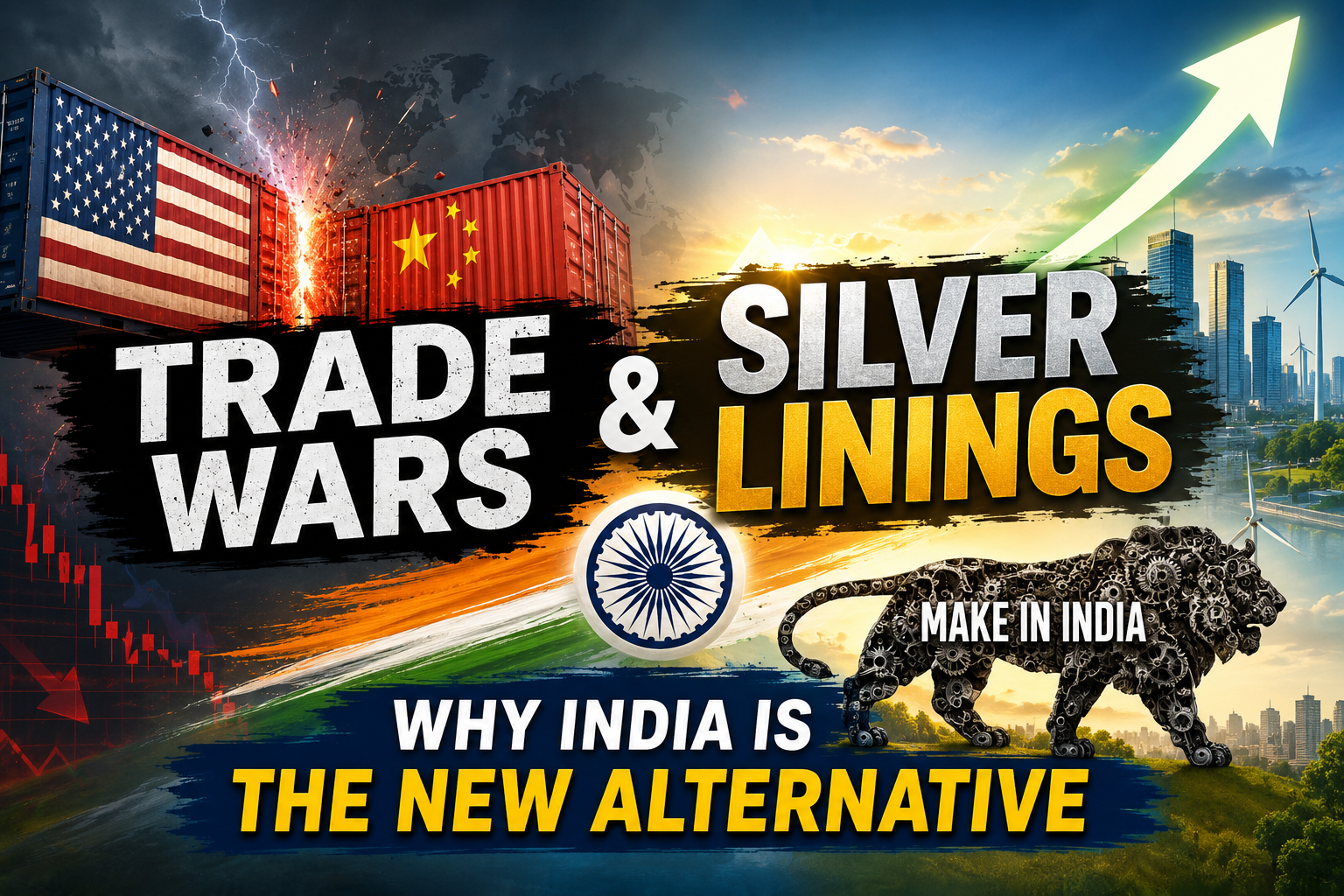
The US tariff shock has created uncertainty across global trade. For India, the immediate concern is clear: higher duties can make exports costlier and hurt price-sensitive sectors. But every trade disruption also forces global buyers to rethink where they source from.
The real question is not whether tariffs are good or bad. The question is whether India can use this moment to become a more reliable alternative in global supply chains.

What’s Creating the Opportunity for India?
The opportunity is not automatic. It comes from a fundamental shift in how global companies are thinking about manufacturing and risk:
- China+1 Strategy: Many global companies want to reduce overdependence on China. India can benefit if it offers scale, stability, and better delivery reliability.
- Export Diversification: Indian sectors such as textiles, engineering goods, electronics, chemicals, pharmaceuticals, and auto components can attract more attention from US buyers.
- Manufacturing Push: With PLI schemes, Make in India, and improving infrastructure, India is trying to move from being a consumption market to a stronger production base.
- US Market Access: The US remains a key Indian export market. Sourcing shifts there offer meaningful opportunities for Indian firms. USTR data shows US goods imports from India hit $103.8 billion in 2025.
The Trade War: Short-Term Shock or Long-Term Shift?
Tariffs create short-term pressure because exporters may face lower margins, delayed orders, or renegotiated contracts.
Beyond the immediate noise, trade wars often change buying behavior. Companies start asking a bigger question: “Can we depend on one country for everything?” That is where India’s long-term opportunity lies. If India can improve quality, logistics, delivery timelines, and compliance standards, this disruption can turn into a structural export advantage.
“The investor of today does not profit from yesterday’s growth. He profits by seeing tomorrow’s opportunity before the crowd does.” — Warren Buffett

Tariff Risks: Is India Fully Safe?
India benefits from and is exposed to the trade war. US tariffs on Indian goods reportedly dropped from 50% to 18%, yet policy uncertainty persists.
Sectors like textiles, gems, and chemicals depend heavily on final tariff treatment and competitiveness. The opportunity exists, but execution will determine the eventual winners. Strategic agility remains the primary safeguard against fluctuating global trade dynamics.
The Bottom Line
US tariffs are not just a trade problem; they are also a total supply-chain reset.
- Short term: Indian exporters may face pricing pressure, margin stress, and order uncertainty.
- Long term: India can gain significantly if it becomes a dependable manufacturing and export hub.
For investors and businesses, the key is to separate temporary tariff excitement from companies with real export strength, scale, quality, and execution. Trade wars reward only the prepared. India has the opening, but true advantage requires converting global uncertainty into dependable supply, superior quality, and stronger execution.
Frequently Asked Questions
- What is the China+1 strategy and how does it help India?
It is a global business strategy where companies diversify their manufacturing outside of China to reduce supply chain risks. India stands to benefit by positioning itself as the primary alternative with its large scale and labor pool. - Why do US tariffs cause short-term shocks to Indian exporters?
Tariffs instantly make goods more expensive for US importers. This forces Indian exporters to either absorb the cost by cutting their profit margins or face lower order volumes and renegotiated contracts. - What role do PLI schemes play in global trade wars?
Production Linked Incentive (PLI) schemes lower production costs and improve infrastructure for domestic manufacturers. This helps Indian businesses maintain competitive pricing even when foreign tariffs increase. - Why did tariffs on Indian goods drop from 50% to 18%?
The drop reflects a shift in bilateral trade deal negotiations and policy adjustments. However, because this rate can fluctuate based on global trade dynamics, long-term policy uncertainty still remains a risk.


