Defense Stocks: Long-Term Theme or Short-Term Sentiment Play?

If you’ve been tracking the markets lately, one sector that has consistently grabbed attention is Defence. With rising geopolitical tensions and global conflicts, governments across the world are ramping up military spending, and Defence companies are directly benefiting from this trend.

But here’s the real question: Is this growth sustainable, or just a short-term reaction to current events?

What’s Driving the Surge in Defence Stocks?

The recent rally in Defence stocks is not random. This isn’t just sentiment, it’s backed by real demand and a combination of strong underlying factors:

  • Increased Global Military Budgets: Countries are prioritizing national security, leading to higher spending on Defence equipment and technology.
  • Government Push for Self-Reliance: Especially in countries like India, initiatives to boost domestic Defence manufacturing are creating long-term opportunities.
  • Export Opportunities: Indian Defence companies are increasingly supplying equipment globally, opening new revenue streams.

The War Factor: Short-Term Trigger or Long-Term Catalyst?

Ongoing conflicts have accelerated the demand for Defence equipment, acting as a short-term trigger for stock price movement. However, the bigger picture is more important. Even beyond current conflicts, the world is entering a phase of heightened geopolitical uncertainty, meaning Defence spending is likely to remain elevated for years.

In simple terms: War may have started the rally, but long-term security concerns could sustain it.

Valuations: Are We Paying Too Much?

While the growth story is strong, many Defence stocks have already seen sharp price increases. This raises key concerns for investors:

  1. Are investors entering too late?
  2. Is the optimism already priced in?

In some cases, stock prices may be running ahead of actual earnings growth, which can lead to short-term corrections. Defence is not just a “news-driven” sector, it requires careful selection.

What Should Investors Watch?

Before investing, it’s important to look beyond headlines and focus on these four pillars:

  • Order books and future contracts
  • Government policy support
  • Export growth potential
  • Company fundamentals (not just momentum)

The Bottom Line

Defence stocks sit at an interesting intersection of short-term triggers and long-term structural growth.

  • Short term: Driven by geopolitical tensions.
  • Long term: Supported by rising global Defence spending.

For investors, the key is to separate hype from opportunity and focus on companies with strong fundamentals rather than chasing momentum. Global uncertainty isn’t going away anytime soon, and neither is the demand for Defence. But smart investing isn’t about reacting to news; it’s about understanding what lies beyond it.

Frequently Asked Questions

  1. Are defense stocks a sustainable long-term investment?
    Yes, because they are supported by long-term structural shifts like rising global military budgets and government initiatives for domestic manufacturing self-reliance.
  2. Is the current rally in defense stocks just due to ongoing wars?
    While conflicts act as a short-term trigger for price movements, the broader catalyst is the phase of heightened geopolitical uncertainty which keeps spending elevated for years.
  3. How does the “Push for Self-Reliance” help Indian defense stocks?
    Initiatives to boost domestic manufacturing create a steady pipeline of long-term opportunities and orders for local companies, reducing dependence on imports.
  4. What are the risks of investing in defense stocks right now?
    The main risk is high valuation. If stock prices run ahead of actual earnings growth, it can lead to short-term corrections even if the company is strong.

Diversification Is Boring: That’s Why It Works

There’s a certain thrill to going “all-in.” When a friend swears by a single mid-cap pharma stock or a cousin doubles his money on a trendy sectoral fund, diversification sounds like the advice a cautious uncle gives at a wedding – sensible, forgettable, and very easy to ignore. However, in the high-stakes world of Indian equities, “boring” is often the engine of sustainable wealth.

Source: NSE/BSE historical data

The Concentration Trap

India’s equity markets have minted legends. But for every Infosys that turned a ₹10,000 SIP into a crore, there’s an ADAG group, a Yes Bank, a DHFL stock that looked invincible right until they weren’t. Concentration risk isn’t theory; it’s the graveyard behind every bull-market brag.

Diversification doesn’t ask you to predict the next winner. It asks you to own enough of the market that when one sector stumbles, the rest keep walking.

What the Numbers Actually Say

Over a typical 10-year period, a diversified Indian equity portfolio blending large caps, mid caps, and some international exposure has historically experienced lower peak-to-trough drawdowns than concentrated sector bets, even when those bets outperform in a good year.

The chart makes the case plainly. A 65% drawdown requires a 186% gain just to break even. A 42% drawdown? You need 72%. The math of losses is crueller than it looks, and diversification simply reduces the hole you have to climb out of.

The Indian Context: More Reasons to Spread Out

Indian retail investors face unique temptations: thematic funds, SME IPOs, and unregulated “tips” from social media groups. We saw this play out during the 2017-18 mid-cap boom, followed by a brutal three-year correction that evaporated wealth built over a decade.

A truly “boring” but effective strategy includes:

  • Asset Diversification: A mix of Large-cap index funds, Flexi-cap funds, and Short-duration debt.
  • Gold & International: Adding a small slice of gold or global equities to hedge against domestic volatility.
  • Time Diversification: Using SIPs to invest steadily across cycles, buying more units when prices fall and fewer when they rise.

Beware of “Di-worsification”

There is one trap to watch out for: owning 14 different mutual funds that all hold the same 30 large-cap stocks. More funds do not necessarily mean more diversification.

If your multi-cap fund and your large-cap fund have a 70% portfolio overlap, you aren’t diversified, you are simply paying two different expense ratios for the same underlying stocks. Always check for correlation to ensure your diversification is meaningful.

The Bottom Line

The goal of investing isn’t to have the best story at a dinner party. It’s to have money when you need it. Diversification won’t make you the most exciting investor in the room, but it’s the one strategy that has quietly and consistently delivered for patient investors across every market cycle.

Frequently Asked Questions

  1. Does diversification mean I will never see a loss in my portfolio?
    No. Diversification doesn’t eliminate market risk, but it significantly reduces “idiosyncratic risk”, the risk of a single company or sector crashing and taking your entire portfolio down with it.
  2. How many mutual funds are enough for a diversified portfolio?
    For most retail investors, 3 to 5 well-chosen funds (covering different market caps and asset classes) are sufficient. Owning too many funds leads to “clapping the market” and higher costs.
  3. Why should I invest in “boring” Large-caps when Mid-caps give higher returns?
    Mid-caps offer growth, but Large-caps provide stability. During market downturns, Large-caps typically fall less, protecting your capital so you have a larger base when the market eventually recovers.
  4. What is portfolio overlap and why does it matter?
    Overlap happens when different funds own the same stocks. If you have high overlap, you aren’t actually spreading your risk; you’re just duplicating your bets and paying extra fees for it.

The Hidden Cost of “Waiting for the Right Time” to Invest

The Myth of the Perfect Entry Point

No one, not fund managers, not analysts, not the sharpest minds on Dalal Street, can consistently predict market bottoms. Lows are only obvious in hindsight. By the time you feel “safe” to invest, the recovery has already begun, and you’ve missed the best gains.

A CRISIL study on Indian equity SIPs found the return difference between the “best” and “worst” day to start investing was just 0.8% over a decade. Obsessing over timing is almost entirely wasted energy. Meanwhile, your money sits in a savings account earning 6-7%, barely outpacing India’s ~6% inflation. Real return? Nearly zero.

What a Delay Actually Costs You

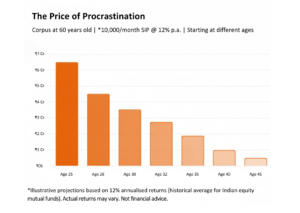
Timing isn’t just about missing a 5% dip; it’s about losing the most powerful force in finance: Compounding. Consider an investor putting ₹10,000 per month into an equity SIP with a 12% annual return, targeting retirement at age 60. Look at how the “Cost of Delay” compounds:

Start Age Monthly Investment Total Years Potential Wealth at 60
25 Years ₹10,000 35 Years ₹6.49 Crore
35 Years ₹10,000 25 Years ₹1.89 Crore
Difference 10 Year Delay ₹4.60 Crore Lost

The Impact: Waiting just a decade doesn’t just cost you 10 years of contributions; it can wipe out nearly ₹4.60 crore in potential terminal wealth. That is compounding working against you, not for you.

Why We Keep Waiting (and How to Stop)

Timing the market is deeply psychological. Financial news amplifies every market hiccup into a potential crash, making caution feel smart when it’s actually expensive.

Certified planners call this analysis paralysis one of the most common wealth destroyers among Indian investors.

The fix is a Systematic Investment Plan (SIP). Invest a fixed amount every month regardless of market levels, and you automatically buy more units when prices are low. Rupee-cost averaging removes the timing decision entirely. You don’t need to be right about the market, you just need to show up consistently.

Time in the Market Beats Timing the Market

India’s mutual fund industry crossed ₹66 lakh crore in AUM in 2025, with monthly SIP inflows consistently above ₹25,000 crore. The retail investors driving this aren’t timing markets, they’re trusting time. You don’t need the Sensex at a magic number. You just need to start. The “right time” you’ve been waiting for? It was yesterday. The second-best time is right now.

The Bottom Line

Markets will always find a reason to look scary: elections, inflation, geopolitical tensions. The noise never stops. But history is clear: investors who stay invested build wealth; those who wait on the sidelines watch it erode. Start your SIP today. Pick a date, any date. Stay invested. Let time do the heavy lifting. That’s not just a strategy. That’s the strategy.

Frequently Asked Questions

  1. Is it better to wait for a market crash to start an SIP?
    No. As the CRISIL study shows, the difference in long-term returns is negligible. Waiting for a crash often means missing out on months of growth that far outweigh the benefit of a slightly lower entry price.
  2. What is the “Cost of Delay”?
    It is the potential wealth lost by not allowing your money to compound. Because compounding is exponential, the “lost” returns from your final years are much larger than the principal you save by waiting.
  3. Does market timing work for long-term goals?
    Rarely. Even professional fund managers struggle with it. For goals like retirement or education, “Time in the market” is statistically proven to be more effective than “Timing the market.”
  4. What is the biggest psychological barrier to starting?
    “Analysis Paralysis.” News cycles make every economic event seem like a crisis. Professional planners suggest automating your first SIP to break the cycle of overthinking.