

The Myth of the Perfect Entry Point
No one, not fund managers, not analysts, not the sharpest minds on Dalal Street, can consistently predict market bottoms. Lows are only obvious in hindsight. By the time you feel “safe” to invest, the recovery has already begun, and you’ve missed the best gains.
A CRISIL study on Indian equity SIPs found the return difference between the “best” and “worst” day to start investing was just 0.8% over a decade. Obsessing over timing is almost entirely wasted energy. Meanwhile, your money sits in a savings account earning 6-7%, barely outpacing India’s ~6% inflation. Real return? Nearly zero.

What a Delay Actually Costs You
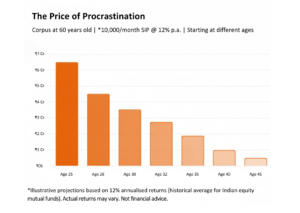
Timing isn’t just about missing a 5% dip; it’s about losing the most powerful force in finance: Compounding. Consider an investor putting ₹10,000 per month into an equity SIP with a 12% annual return, targeting retirement at age 60. Look at how the “Cost of Delay” compounds:
| Start Age | Monthly Investment | Total Years | Potential Wealth at 60 |
| 25 Years | ₹10,000 | 35 Years | ₹6.49 Crore |
| 35 Years | ₹10,000 | 25 Years | ₹1.89 Crore |
| Difference | 10 Year Delay | ₹4.60 Crore Lost |
The Impact: Waiting just a decade doesn’t just cost you 10 years of contributions; it can wipe out nearly ₹4.60 crore in potential terminal wealth. That is compounding working against you, not for you.
Why We Keep Waiting (and How to Stop)
Timing the market is deeply psychological. Financial news amplifies every market hiccup into a potential crash, making caution feel smart when it’s actually expensive.
Certified planners call this analysis paralysis one of the most common wealth destroyers among Indian investors.
The fix is a Systematic Investment Plan (SIP). Invest a fixed amount every month regardless of market levels, and you automatically buy more units when prices are low. Rupee-cost averaging removes the timing decision entirely. You don’t need to be right about the market, you just need to show up consistently.
Time in the Market Beats Timing the Market
India’s mutual fund industry crossed ₹66 lakh crore in AUM in 2025, with monthly SIP inflows consistently above ₹25,000 crore. The retail investors driving this aren’t timing markets, they’re trusting time. You don’t need the Sensex at a magic number. You just need to start. The “right time” you’ve been waiting for? It was yesterday. The second-best time is right now.
The Bottom Line
Markets will always find a reason to look scary: elections, inflation, geopolitical tensions. The noise never stops. But history is clear: investors who stay invested build wealth; those who wait on the sidelines watch it erode. Start your SIP today. Pick a date, any date. Stay invested. Let time do the heavy lifting. That’s not just a strategy. That’s the strategy.
Frequently Asked Questions
- Is it better to wait for a market crash to start an SIP?
No. As the CRISIL study shows, the difference in long-term returns is negligible. Waiting for a crash often means missing out on months of growth that far outweigh the benefit of a slightly lower entry price. - What is the “Cost of Delay”?
It is the potential wealth lost by not allowing your money to compound. Because compounding is exponential, the “lost” returns from your final years are much larger than the principal you save by waiting. - Does market timing work for long-term goals?
Rarely. Even professional fund managers struggle with it. For goals like retirement or education, “Time in the market” is statistically proven to be more effective than “Timing the market.” - What is the biggest psychological barrier to starting?
“Analysis Paralysis.” News cycles make every economic event seem like a crisis. Professional planners suggest automating your first SIP to break the cycle of overthinking.


