

Interest rates are one of the most powerful forces in financial markets. When central banks raise rates, the immediate focus is often on borrowing costs, but the deeper impact is on how equities are valued. As rates rise, the fundamental way investors look at future earnings begins to change.
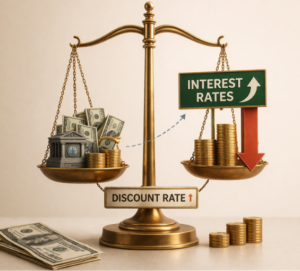
Why Interest Rates Matter for Stocks
Higher interest rates affect equities through multiple channels, directly influencing how investors assess company performance and growth potential:
- Cost of Borrowing Increases: Companies face higher interest expenses on their loans, which can directly eat into their net profitability.
- Lower Consumer Spending: When loans for cars, homes, and credit cards become expensive, consumers spend less, affecting overall company revenues.
- Shift in Investment Preference: As yields on “safe” fixed-income instruments (like FDs or Bonds) rise, they become more attractive compared to the riskier equity market.
How Valuations Get Impacted
The effect of rising rates is most visible in valuation multiples. It all comes down to the math of “Discounted Cash Flows”:
- Present Value Compression: Future earnings are discounted at higher rates, which reduces their value in today’s terms.
- Growth Correction: High-growth companies, whose value is based on earnings far into the future, tend to see sharper valuation corrections.
- P/E Compression: Price-to-earnings (P/E) multiples often shrink across the board during rate hike cycles.
In simple terms: When interest rates rise, the value investors assign to future growth comes down.

Not All Sectors React the Same Way
Interest rate changes create a divergence in sectoral performance:
- Growth Sectors (Tech, Startups): These are more sensitive because their high valuations rely heavily on earnings promised years down the line.
- Banking & Financials: These can actually benefit from higher lending rates, which often lead to improved net interest margins.
- Capital-Intensive Industries: Sectors like Infrastructure or Real Estate face immediate pressure due to higher borrowing costs for their massive projects.
What Needs Attention During Such Phases
A rising rate environment requires investors to shift their focus from aggressive growth to financial stability. Look closely at:
- Debt Levels: Highly leveraged companies (those with high debt-to-equity) may face significant financial stress.
- Cash Flow Strength: Strong, stable, and positive cash flows become more valuable than “potential” future profit.
- Earnings Visibility: Companies with predictable and transparent earnings tend to hold up better against market volatility.
The Bigger Picture
Interest rate cycles often redefine market behaviour. In the short term, you will see valuation corrections and high volatility. In the long term, the market tends to shift toward fundamentally strong businesses that can withstand higher costs.
Interest rates don’t just affect borrowing, they shape how markets think about value. As rates rise, the focus moves from future potential to present strength.
Frequently Asked Questions
- Why do stock prices fall when interest rates go up?
When rates rise, the “discount rate” used to value future profits also rises. Mathematically, this makes a company’s future earnings worth less today, leading to a drop in stock price. - Which types of companies are hit hardest by rate hikes?
Companies with high debt and “Growth” companies (like Tech) that are not yet profitable are hit hardest. They rely on cheap capital to grow, which disappears when rates rise. - Can rising interest rates ever be good for the stock market?
In the short term, it usually causes a dip. However, banks and financial institutions often see higher profits as they charge more for loans, which can support their stock prices. - What is “P/E Compression”?
It is when investors are no longer willing to pay a high multiple (like 50x earnings) for a stock because they can get a better, safer return from bonds. The “Price” drops even if the “Earnings” stay the same.


