Investing During Crisis: Key Sectors to Watch

When global conflicts bring volatility and fear into financial markets, broad movements become unpredictable and investor sentiment weakens. However, while uncertainty increases, certain sectors begin to attract more attention. The focus gradually shifts from overall market direction to identifying pockets where demand is building.

Sectors That Gain Attention During a Crisis

During periods of conflict, economic priorities shift, leading to increased demand in a few key areas. These movements are not random; they reflect real changes in global demand and policy direction:

  • Defence: Governments increase military spending, supporting companies involved in equipment, technology, and infrastructure.
  • Commodities: Oil, gas, and metals react sharply due to supply disruptions and geopolitical risks.
  • Safe-Haven Assets: Gold gains importance as investors look for stability during uncertain times.

How War Impacts Different Asset Classes

Conflicts create uneven movement across markets rather than a uniform trend. While the overall market may appear unstable, certain sectors can see stronger activity:

  • Rising oil prices influence energy-linked sectors.
  • Increased Defence budgets support long-term contracts.
  • Supply chain disruptions push commodity prices higher.

Beyond Stocks: Where Else Does Money Move?

Crisis periods also shift attention beyond traditional equities as investors look to balance portfolios:

  • Gold as a store of value.
  • Commodities as a hedge against inflation.
  • Global exposure to reduce concentration risk.

What Needs Attention During Such Phases

Even when opportunities emerge, certain risks remain. Maintaining discipline becomes vital, as you must avoid:

  1. Entering after sharp price increases.
  2. Following short-term news instead of underlying trends.
  3. Ignoring long-term positioning in favour of quick gains.

The Bigger Picture

Crisis periods reshape how capital flows across markets. In the short term, you will see volatility and quick reactions. However, the long-term often reveals sustained demand in key sectors.

Understanding this shift helps in interpreting market behaviour more clearly. Uncertainty changes market behaviour, but it also highlights where future demand is building. The focus isn’t on predicting crises, but on observing how different sectors respond to them.

Frequently Asked Questions

  1. Why does gold become a “safe-haven” during a market crisis?
    Investors look for stability when paper assets like stocks become volatile. Gold is viewed as a store of value that doesn’t depend on any single government or corporation, making it a hedge against geopolitical risk.
  2. How do rising oil prices impact energy-linked sectors?
    Conflicts in oil-producing regions often lead to supply disruptions. This pushes prices higher, which can benefit energy producers but can increase costs for transportation and manufacturing sectors.
  3. Are defence budget increases immediate?
    While the sentiment shifts quickly, actual increases in defence budgets often lead to long-term contracts. These provide sustained revenue visibility for companies involved in technology and infrastructure.
  4. What is the risk of “chasing the news” during a crisis?
    By the time a crisis makes the headlines, prices in sectors like defence or commodities may have already jumped. Entering at these peaks based on news can lead to losses if the situation stabilizes.

Defense Stocks: Long-Term Theme or Short-Term Sentiment Play?

If you’ve been tracking the markets lately, one sector that has consistently grabbed attention is Defence. With rising geopolitical tensions and global conflicts, governments across the world are ramping up military spending, and Defence companies are directly benefiting from this trend.

But here’s the real question: Is this growth sustainable, or just a short-term reaction to current events?

What’s Driving the Surge in Defence Stocks?

The recent rally in Defence stocks is not random. This isn’t just sentiment, it’s backed by real demand and a combination of strong underlying factors:

  • Increased Global Military Budgets: Countries are prioritizing national security, leading to higher spending on Defence equipment and technology.
  • Government Push for Self-Reliance: Especially in countries like India, initiatives to boost domestic Defence manufacturing are creating long-term opportunities.
  • Export Opportunities: Indian Defence companies are increasingly supplying equipment globally, opening new revenue streams.

The War Factor: Short-Term Trigger or Long-Term Catalyst?

Ongoing conflicts have accelerated the demand for Defence equipment, acting as a short-term trigger for stock price movement. However, the bigger picture is more important. Even beyond current conflicts, the world is entering a phase of heightened geopolitical uncertainty, meaning Defence spending is likely to remain elevated for years.

In simple terms: War may have started the rally, but long-term security concerns could sustain it.

Valuations: Are We Paying Too Much?

While the growth story is strong, many Defence stocks have already seen sharp price increases. This raises key concerns for investors:

  1. Are investors entering too late?
  2. Is the optimism already priced in?

In some cases, stock prices may be running ahead of actual earnings growth, which can lead to short-term corrections. Defence is not just a “news-driven” sector, it requires careful selection.

What Should Investors Watch?

Before investing, it’s important to look beyond headlines and focus on these four pillars:

  • Order books and future contracts
  • Government policy support
  • Export growth potential
  • Company fundamentals (not just momentum)

The Bottom Line

Defence stocks sit at an interesting intersection of short-term triggers and long-term structural growth.

  • Short term: Driven by geopolitical tensions.
  • Long term: Supported by rising global Defence spending.

For investors, the key is to separate hype from opportunity and focus on companies with strong fundamentals rather than chasing momentum. Global uncertainty isn’t going away anytime soon, and neither is the demand for Defence. But smart investing isn’t about reacting to news; it’s about understanding what lies beyond it.

Frequently Asked Questions

  1. Are defense stocks a sustainable long-term investment?
    Yes, because they are supported by long-term structural shifts like rising global military budgets and government initiatives for domestic manufacturing self-reliance.
  2. Is the current rally in defense stocks just due to ongoing wars?
    While conflicts act as a short-term trigger for price movements, the broader catalyst is the phase of heightened geopolitical uncertainty which keeps spending elevated for years.
  3. How does the “Push for Self-Reliance” help Indian defense stocks?
    Initiatives to boost domestic manufacturing create a steady pipeline of long-term opportunities and orders for local companies, reducing dependence on imports.
  4. What are the risks of investing in defense stocks right now?
    The main risk is high valuation. If stock prices run ahead of actual earnings growth, it can lead to short-term corrections even if the company is strong.

When Should You Stop Checking Your Portfolio?

If you’re opening your Zerodha or Groww app every morning before chai, you might be your own worst enemy. Science says so, and the data is pretty clear.

India’s retail investor base has exploded. Over 15 crore demat accounts are now active, and with real-time dashboards at our fingertips, checking the portfolio has become a reflex. Red day on the Sensex? We check. RBI announcement? We check. Bored on the metro? We check. But here’s the uncomfortable truth: the more you look, the more likely you are to lose.

The Brain Trap: Myopic Loss Aversion

Economists Daniel Kahneman and Amos Tversky identified a psychological bias called Myopic Loss Aversion. This is the tendency to feel the pain of a loss roughly twice as intensely as the pleasure of an equivalent gain.

When you check your portfolio daily, you are statistically guaranteed to see “red” numbers frequently. Your brain reacts disproportionately to these minor dips, leading to:

  • Panic Selling: Exiting a great fund during a temporary market breather.
  • Over-Trading: Attempting to “fix” a portfolio that isn’t broken.
  • Lower Risk Appetite: Frequent feedback makes investors too cautious, causing them to miss out on the equity risk premium.

What the Data Actually Shows

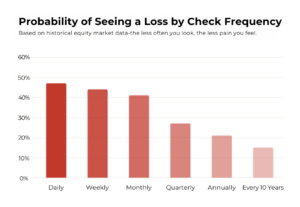
The odds of witnessing a loss shrink dramatically the less frequently you look. Markets are volatile in the short run (noise), but they trend upward over time (signal).

  • Daily Checkers: You are essentially flipping a coin. The probability of seeing a gain vs. a loss is nearly 50/50.
  • Annual Checkers: The probability of seeing a positive number jumps significantly.
  • The “Dead Investor” Theory: A famous internal study by Fidelity reportedly found that their best-performing accounts belonged to investors who had either forgotten their passwords or had passed away. The common thread? Zero meddling.

What This Means for Indian Investors

The Indian market context makes this even more relevant. The Nifty 50 has delivered roughly 12–14% annualised returns over the long term, but only to those who stayed invested. The typical retail investor, spooked by volatility, tends to exit at lows and re-enter at highs, systematically underperforming the index they could have just held.

SIP investors in Indian mutual funds who stayed the course through COVID-19, Budget volatility, and global rate cycles have largely come out ahead. Those who tinkered with checking daily and reacting emotionally often did not.

So, How Often Should You Check?

For most investors, a quarterly review is the “sweet spot.” Use this time to:

  • Ensure your asset allocation hasn’t drifted too far (e.g., from 70% equity to 85%).
  • Confirm your SIPs are processing correctly.
  • Verify there are no major structural changes in your core fund holdings.

Beyond that, close the app. If you are a long-term mutual fund investor, even an annual review is perfectly sufficient, and frankly, much healthier for your mental well-being.

The best investment habit you can build in 2026 isn’t a new stock-picking strategy; it’s the discipline to look away. Set price alerts for extreme moves if you must, but otherwise, let compounding do its quiet, patient work.

Frequently Asked Questions

  1. Why does checking my portfolio daily lead to losses?
    It triggers emotional reactions to short-term volatility. When you see a dip, the “pain” of the loss often leads to impulsive decisions, like stopping an SIP or selling a quality fund, which disrupts compounding.
  2. Is a quarterly review enough to catch a market crash?
    Yes. Market crashes are part of the equity journey. Since you cannot predict them, checking daily doesn’t help you avoid them, it only increases the chance that you will panic-sell at the bottom.
  3. What should I do if I see a 10% dip during my quarterly review?
    Check if the fundamentals of your investments have changed. If the dip is due to general market sentiment (like an RBI rate hike or global cues), the best move is usually to do nothing and let your SIPs continue.
  4. Won’t I miss out on “buying the dip” if I don’t check daily?
    You can set automated price alerts (e.g., if the Nifty drops 5%) instead of manually checking every day. This allows you to act on opportunities without being consumed by daily noise.

Navigating Market Noise: 5 Common Investor Mistakes

Volatility is a feature of Indian equity markets, but sharp weekly moves of 2–3% in the Nifty 50 can unsettle even experienced retail investors. With retail participation at record highs and demat accounts crossing 200 million as of late 2025, avoiding behavioural mistakes is critical for protecting long-term wealth. Below are five common errors investors make during market turbulence.

  • Panic-Stopping SIPs 

      • When the market dips, the instinct is to sell and wait for things to settle before buying again. This behaviour often proves counterproductive, as it locks in losses instead of allowing portfolios time to recover. Historically, investors who continued their Systematic Investment Plans (SIPs) through volatile periods such as the 2020 crash or the 2022 rate hike cycle benefited from rupee cost averaging. 
      • The Data: Stopping an SIP during a 10% market correction can reduce your 10-year terminal wealth by nearly 15–20% due to the loss of “cheap” units accumulated during the dip. 
  • Revenge Trading in F&O 

      • New investors often try to “make back” spot market losses by pivoting to Futures & Options (F&O). This is a high-risk gamble. 
      • The Data: SEBI’s landmark study revealed that 9 out of 10 individual traders in the equity F&O segment incurred net losses, with an average loss of ₹1.1 Lakh per person. Volatility expands option premiums, making “guessing the bottom” an expensive mistake. 
  • Ignoring the “Cash is King” Rule 

      • Many new investors remain 100% deployed at all times. Without a cash buffer, you cannot capitalize on “discounts” during a correction. 
      • The Quantitative Fix: Maintaining a 5–10% cash/liquid fund tactical allocation allows you to deploy capital when the Nifty P/E ratio drops below its 10-year average (historically around 20x–22x), offering better Margin of Safety. 
  • Over-Concentration in Small-Caps 

      • During bull runs, small-caps offer multi-bagger returns, but they are the hardest hit during volatility. 
      • The Data: In a standard market correction, Small-cap indices often see drawdowns of 25–30%, while the Nifty 50 might only drop 10–12%. Over-leveraging in small-cap stocks without a Large-cap “anchor” leads to portfolio wipeouts. 
  • Anchoring to “All-Time Highs” 

    • New investors often refuse to sell a non-performing stock because they are waiting for it to return to its peak price. In a volatile market, some stocks may never recover to those levels. 
    • The Strategy: Instead of price anchoring, focus on earnings growth. If a company’s EPS (Earnings Per Share) is declining while volatility is increasing, holding on is a “sunk cost” fallacy.

Frequently Asked Questions

  1. Why should investors avoid stopping SIPs during market volatility?
    Stopping SIPs during a market dip can reduce long-term returns because investors miss the opportunity to buy units at lower prices.
  2. Why is revenge trading in F&O risky?
    Futures and Options are highly volatile, and many retail traders lose money trying to recover losses quickly through risky trades.
  3. Why is keeping some cash important for investors?
    A cash reserve allows investors to buy quality stocks or funds at lower prices during market corrections.
  4. Why is over-investing in small-cap stocks risky?
    Small-cap stocks can fall much more during market corrections, which can lead to larger portfolio losses if not balanced with large-cap investments.