Diversification Is Boring: That’s Why It Works

There’s a certain thrill to going “all-in.” When a friend swears by a single mid-cap pharma stock or a cousin doubles his money on a trendy sectoral fund, diversification sounds like the advice a cautious uncle gives at a wedding – sensible, forgettable, and very easy to ignore. However, in the high-stakes world of Indian equities, “boring” is often the engine of sustainable wealth.

Source: NSE/BSE historical data

The Concentration Trap

India’s equity markets have minted legends. But for every Infosys that turned a ₹10,000 SIP into a crore, there’s an ADAG group, a Yes Bank, a DHFL stock that looked invincible right until they weren’t. Concentration risk isn’t theory; it’s the graveyard behind every bull-market brag.

Diversification doesn’t ask you to predict the next winner. It asks you to own enough of the market that when one sector stumbles, the rest keep walking.

What the Numbers Actually Say

Over a typical 10-year period, a diversified Indian equity portfolio blending large caps, mid caps, and some international exposure has historically experienced lower peak-to-trough drawdowns than concentrated sector bets, even when those bets outperform in a good year.

The chart makes the case plainly. A 65% drawdown requires a 186% gain just to break even. A 42% drawdown? You need 72%. The math of losses is crueller than it looks, and diversification simply reduces the hole you have to climb out of.

The Indian Context: More Reasons to Spread Out

Indian retail investors face unique temptations: thematic funds, SME IPOs, and unregulated “tips” from social media groups. We saw this play out during the 2017-18 mid-cap boom, followed by a brutal three-year correction that evaporated wealth built over a decade.

A truly “boring” but effective strategy includes:

  • Asset Diversification: A mix of Large-cap index funds, Flexi-cap funds, and Short-duration debt.
  • Gold & International: Adding a small slice of gold or global equities to hedge against domestic volatility.
  • Time Diversification: Using SIPs to invest steadily across cycles, buying more units when prices fall and fewer when they rise.

Beware of “Di-worsification”

There is one trap to watch out for: owning 14 different mutual funds that all hold the same 30 large-cap stocks. More funds do not necessarily mean more diversification.

If your multi-cap fund and your large-cap fund have a 70% portfolio overlap, you aren’t diversified, you are simply paying two different expense ratios for the same underlying stocks. Always check for correlation to ensure your diversification is meaningful.

The Bottom Line

The goal of investing isn’t to have the best story at a dinner party. It’s to have money when you need it. Diversification won’t make you the most exciting investor in the room, but it’s the one strategy that has quietly and consistently delivered for patient investors across every market cycle.

Frequently Asked Questions

  1. Does diversification mean I will never see a loss in my portfolio?
    No. Diversification doesn’t eliminate market risk, but it significantly reduces “idiosyncratic risk”, the risk of a single company or sector crashing and taking your entire portfolio down with it.
  2. How many mutual funds are enough for a diversified portfolio?
    For most retail investors, 3 to 5 well-chosen funds (covering different market caps and asset classes) are sufficient. Owning too many funds leads to “clapping the market” and higher costs.
  3. Why should I invest in “boring” Large-caps when Mid-caps give higher returns?
    Mid-caps offer growth, but Large-caps provide stability. During market downturns, Large-caps typically fall less, protecting your capital so you have a larger base when the market eventually recovers.
  4. What is portfolio overlap and why does it matter?
    Overlap happens when different funds own the same stocks. If you have high overlap, you aren’t actually spreading your risk; you’re just duplicating your bets and paying extra fees for it.


The Hidden Cost of “Waiting for the Right Time” to Invest

The Myth of the Perfect Entry Point

No one, not fund managers, not analysts, not the sharpest minds on Dalal Street, can consistently predict market bottoms. Lows are only obvious in hindsight. By the time you feel “safe” to invest, the recovery has already begun, and you’ve missed the best gains.

A CRISIL study on Indian equity SIPs found the return difference between the “best” and “worst” day to start investing was just 0.8% over a decade. Obsessing over timing is almost entirely wasted energy. Meanwhile, your money sits in a savings account earning 6-7%, barely outpacing India’s ~6% inflation. Real return? Nearly zero.

What a Delay Actually Costs You

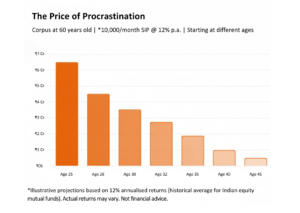
Timing isn’t just about missing a 5% dip; it’s about losing the most powerful force in finance: Compounding. Consider an investor putting ₹10,000 per month into an equity SIP with a 12% annual return, targeting retirement at age 60. Look at how the “Cost of Delay” compounds:

Start Age Monthly Investment Total Years Potential Wealth at 60
25 Years ₹10,000 35 Years ₹6.49 Crore
35 Years ₹10,000 25 Years ₹1.89 Crore
Difference 10 Year Delay ₹4.60 Crore Lost

The Impact: Waiting just a decade doesn’t just cost you 10 years of contributions; it can wipe out nearly ₹4.60 crore in potential terminal wealth. That is compounding working against you, not for you.

Why We Keep Waiting (and How to Stop)

Timing the market is deeply psychological. Financial news amplifies every market hiccup into a potential crash, making caution feel smart when it’s actually expensive.

Certified planners call this analysis paralysis one of the most common wealth destroyers among Indian investors.

The fix is a Systematic Investment Plan (SIP). Invest a fixed amount every month regardless of market levels, and you automatically buy more units when prices are low. Rupee-cost averaging removes the timing decision entirely. You don’t need to be right about the market, you just need to show up consistently.

Time in the Market Beats Timing the Market

India’s mutual fund industry crossed ₹66 lakh crore in AUM in 2025, with monthly SIP inflows consistently above ₹25,000 crore. The retail investors driving this aren’t timing markets, they’re trusting time. You don’t need the Sensex at a magic number. You just need to start. The “right time” you’ve been waiting for? It was yesterday. The second-best time is right now.

The Bottom Line

Markets will always find a reason to look scary: elections, inflation, geopolitical tensions. The noise never stops. But history is clear: investors who stay invested build wealth; those who wait on the sidelines watch it erode. Start your SIP today. Pick a date, any date. Stay invested. Let time do the heavy lifting. That’s not just a strategy. That’s the strategy.

Frequently Asked Questions

  1. Is it better to wait for a market crash to start an SIP?
    No. As the CRISIL study shows, the difference in long-term returns is negligible. Waiting for a crash often means missing out on months of growth that far outweigh the benefit of a slightly lower entry price.
  2. What is the “Cost of Delay”?
    It is the potential wealth lost by not allowing your money to compound. Because compounding is exponential, the “lost” returns from your final years are much larger than the principal you save by waiting.
  3. Does market timing work for long-term goals?
    Rarely. Even professional fund managers struggle with it. For goals like retirement or education, “Time in the market” is statistically proven to be more effective than “Timing the market.”
  4. What is the biggest psychological barrier to starting?
    “Analysis Paralysis.” News cycles make every economic event seem like a crisis. Professional planners suggest automating your first SIP to break the cycle of overthinking.

Why Smart Money Prefers Indirect Investing?

In India’s Demat Revolution, retail participation is at record highs, with over 200 million demat accounts and monthly SIP inflows of ₹28,000 crore. Yet a divide remains. While many investors chase multibaggers through direct stocks, smart money like institutions and seasoned HNIs increasingly prefers indirect investing via mutual funds and index funds. Here is why this backseat approach may be the smarter choice for your portfolio:

  • The “Skill vs. Luck” Ratio 
      • Most retail investors treat direct stocks as a hit-or miss game. Smart money focuses on probabilities, using data and research teams that retail investors cannot match. 
        • The Data: A 2025 SEBI report showed that over 85% of retail direct stock portfolios failed to beat the Nifty 50 over three years. Over the last five years, the Nifty 50 delivered annualised returns of around 12–13%, while top Flexi cap funds generated average annualised returns of 16.08% during the same period.
        • The Strategy: Instead of spending hours on individual stocks, delegate to professionals. The goal is not to be right once, but to build consistent wealth over a decade. 

  • Diversification as a Survival Shield 
      • New investors often fall in love with themes like green energy or AI and over-concentrate. Smart money understands that sector leadership in India keeps rotating. 
        • The Data: In late 2025, some small-cap indices delivered negative returns due to valuation bubbles, while diversified equity funds stayed resilient by spreading across 50 to 70 companies. 
        • The Strategy: Use indirect investing for instant diversification. If one sector slows, growth in others like banking or consumption helps protect capital. 
  • Avoiding “Tax & Transaction” Leakage 
      • Direct trading is costly. Frequent portfolio churn to book short-term profits leads to losses from brokerage, STT, and 15% STCG tax. 
        • The Quantitative Fix: Active traders often lose 2% to 4% of their potential corpus annually to taxes and costs. In mutual funds, rebalancing happens without triggering taxes. You pay tax only when you withdraw years later
  • Overcoming the Emotional “Panic” Trigger 
    • Direct investing is highly emotional. A 7% single day fall often triggers impulsive selling. Indirect investing creates psychological distance that supports discipline. 
      • The Data: AMFI research shows SIP investors hold investments three times longer than direct equity traders. This discipline has pushed retail investors to a record 44% share of equity fund assets. 

The Strategy: Automate discipline by avoiding daily buy-sell decisions to protect long-term compounding.

Conclusion

The shift toward indirect investing is not a sign of giving up. It reflects maturity. Smart money understands that in a fast-moving and complex economy, consistency matters more than intensity. By choosing the indirect route, investors gain professional management, diversification, and tax efficiency. As India moves toward Capital Markets 3.0, winners will not be those who find the next big idea once, but those who stay invested in the entire growth story through a disciplined indirect approach.

Frequently Asked Questions

  1. What is indirect investing?
    Indirect investing means investing through mutual funds or index funds instead of buying individual stocks directly.
  2. Why do many experienced investors prefer indirect investing?
    Indirect investing provides professional management and diversification, which can help improve long-term returns and reduce risk.
  3. How does indirect investing help with diversification?
    Mutual funds and index funds invest in many companies across sectors, reducing the risk of losses from a single stock.
  4. Is indirect investing more tax-efficient than direct trading?
    Yes. Mutual funds allow portfolio rebalancing without immediate taxes, while frequent stock trading can trigger brokerage costs and short-term capital gains tax.


The Psychology Behind Panic Selling And How To Avoid It

Why Indian Investors Press the ‘Sell’ Button in Fear

Panic selling comes from the brain’s fight or flight response. When the Sensex falls 1,000 points in a day, fear takes over and weakens rational thinking. Loss aversion makes a 10% portfolio fall feel disastrous, even if overall gains are 30%. Rajesh Kumar, a Mumbai-based software engineer, recalls March 2020, when his portfolio fell ₹2.5 lakhs in two days. Influenced by WhatsApp panic, he sold at the bottom and locked in losses he could have recovered within six months.

The Herd Mentality Trap

Indians are particularly susceptible to social proof bias. When neighbours, relatives, and Telegram groups scream “sell everything,” we follow blindly. This collective panic creates crashes. During the 2024 election result volatility, the Nifty dropped 6% intraday before recovering fully within two sessions, yet lakhs of retail investors had already exited.

The Numbers Don’t Lie

Research shows investors who panic sold during the 2020 COVID crash missed the 75% Nifty 50 rally between March 2020 and February 2021. A SEBI study found 95% of individual F&O traders lost money between FY19 and FY22 due to emotional decisions. Despite crashes, the Sensex has delivered 12-15% CAGR over 20 years, with every major fall followed by new highs within one to three years.

Understanding Recency Bias

We give disproportionate weight to recent events. A single bad week erases memories of two good years. This recency bias makes us forget that markets are cyclical. Adani Group’s 2023 crash made investors dump all Adani stocks, but those who held Adani Ports recovered fully within eight months.

How to Protect Yourself

  • Build a Financial Cushion: Keep 6–12 months of expenses in liquid funds or savings accounts to avoid selling investments during stress. 
  • Avoid Constant Monitoring: Daily portfolio checks increase anxiety. Priya Sharma reviews investments quarterly, improving returns 12% annually. 
  • Set Rules, Not Emotions: Decide timelines in advance. For goals 15 years away, short-term drops are irrelevant. SIPs buy more units during falls through rupee cost averaging. 
  • Diversify Beyond Headlines: Avoid exposure to trending sectors. Spread across large caps, debt, gold, and international funds. In 2022, diversified portfolios fell 12–15% despite IT crashing. 
  • Use Stop Loss Wisely: Set a 20–25% stop loss for individual stocks. Avoid stop losses for long-term mutual funds meant for staying invested. 
  • Question the News Cycle: Media amplifies fear. A 500-point Sensex fall is only 0.6%. Focus on percentages and context, not headlines.
  • Remember Your ‘Why’: Write down investment goals and review them during panic. Short-term noise should not derail long-term wealth creation.

The Contrarian Advantage

Successful investors like Rakesh Jhunjhunwala bought during the 2008 crash when others were selling. History shows wealth is created by those who buy during panic. As retail investors sold ₹40,000 crores in March 2020, smart money accumulated quality stocks. The market rewards patience over panic. As Warren Buffett said, markets transfer money from the impatient to the patient. Your biggest enemy is often yourself.

Frequently Asked Questions

  1. Why do investors panic sell during market crashes?
    Panic selling happens when fear and loss aversion take over, causing investors to react emotionally to falling prices.
  2. What is herd mentality in investing?
    Herd mentality occurs when investors follow others’ actions, like friends, social media, or news—without doing their own analysis.
  3. How does panic selling affect long-term returns?
    Selling during market declines locks in losses and can make investors miss the recovery that often follows.
  4. How can investors avoid panic selling?
    Investors can avoid panic selling by focusing on long-term goals, diversifying their portfolio, and avoiding constant market monitoring.


How Time Beats Volatility in the Stock Market

How Time Beats Volatility in the Stock Market

Investing in the stock market is often perceived as a roller-coaster ride of unpredictable highs and lows. However, time has proven to be a powerful ally in mitigating the effects of market volatility. In this article, we’ll delve into how time beats volatility in the stock market, why long-term investing is a winning strategy, and how you can leverage time to sustain wealth.

Understanding Market Volatility

Market volatility refers to the rapid and unpredictable fluctuations in stock prices. While it can be daunting for short-term traders, long-term investors can use volatility to their advantage. Instead of reacting to market dips and peaks, seasoned investors adopt a long-term perspective, allowing them to ride out market cycles and reap significant returns.

Key Takeaway: Volatility is a natural part of the stock market. It is not something to fear but rather a phenomenon to understand and manage effectively.

The Power of Time in Investing

Time is the most critical factor in mitigating volatility. Here’s how:

1. Compounding Effect: The longer you stay invested, the more time your investments have to grow through compounding. Compounding generates returns on both your initial investment and the accumulated returns, creating exponential growth over time.

Example: If you invest ₹1,00,000 at an annual return of 10%, your investment will grow to approximately ₹2,59,000 in 10 years and over ₹6,72,000 in 20 years. The longer you remain invested, the greater the impact of compounding.

2. Market Cycles Even Out: Over the short term, the stock market can be highly volatile, reacting to economic news, geopolitical events, and investor sentiment. However, over the long term, these fluctuations tend to average out.

Historical data shows that despite periodic crashes, the market has always trended upwards in the long run. For instance, the BSE Sensex, which was around 100 points in 1979, crossed 66,000 points in 2023.

3. Cost Averaging: Regular investments through methods like SIP (Systematic Investment Plan) allow investors to average the cost of their investments. When the market is down, you buy more units; when the market is up, you buy fewer units. This strategy reduces the impact of short-term volatility.

Why Short-Term Trading is Risky

Short-term trading involves buying and selling stocks based on market movements. While some traders may make quick profits, the majority end up losing money due to:

  • Emotional Decision-Making: Fear and greed often drive short-term traders, leading to irrational decisions.
  • Transaction Costs: Frequent buying and selling can rack up significant brokerage fees and taxes, reducing overall returns.
  • Market Timing Risks: Predicting market movements accurately is nearly impossible, even for experienced investors.

Case Study: The 2008 Financial Crisis

The 2008 financial crisis is a prime example of how long-term investing can outlast short-term volatility. During the crisis, the stock market plummeted by nearly 50%, and investors who panicked and sold off their assets incurred massive losses.

However, those who remained invested and continued to contribute to their portfolios saw their investments recover and grow significantly over the next decade. By 2021, the market had not only recovered but also reached record highs.

Lesson: Staying invested during volatile periods can yield substantial long-term gains.

Strategies to Leverage Time in the Stock Market


  1. Start Early: The earlier you start investing, the more time your investments have to compound. Even small investments can grow significantly over 15-20 years.
  2. Diversify Your Portfolio: A well-diversified portfolio reduces risk and smoothens returns over time. Include a mix of large-cap, mid-cap, and small-cap stocks, along with bonds and mutual funds.
  3. Invest Consistently: Regular investments, such as monthly SIP, help in rupee cost averaging and mitigate the impact of short-term volatility.
  4. Focus on Quality Stocks: Invest in fundamentally strong companies with a history of consistent earnings, robust management, and sustainable growth.
  5. Stay Disciplined: Avoid reacting to short-term market noise. Stick to your investment plan and review your portfolio periodically, but avoid impulsive decisions based on market fluctuations.

How to Stay Calm During Volatile Markets

  • Stay Informed but Not Obsessed: Keep track of market news but avoid checking your portfolio daily.
  • Revisit Your Financial Goals: Remind yourself why you started investing — long-term wealth creation, retirement planning, or financial independence.
  • Seek Professional Guidance: Consult a financial advisor to help you maintain a steady investment strategy during market turmoil.

Conclusion

Time is the ultimate weapon against market volatility. While short-term market movements may be unpredictable, the long-term trend of the stock market has historically been upward. By focusing on compounding, cost averaging, and disciplined investing, you can navigate market volatility with confidence and build wealth sustainably.

Are you ready to harness the power of time to beat volatility and achieve your financial goals? Start investing today and let time work its magic.

Frequently Asked Questions

  1. How does time help in reducing the impact of stock market volatility?

Time allows investments to recover from short-term market fluctuations. Over the long term, the stock market has historically trended upward, averaging out periods of volatility and generating positive returns.

  1. What is compounding, and how does it work in long-term investing?

Compounding is the process where your investment earns returns, and those returns generate additional returns over time. The longer you stay invested, the more powerful the compounding effect becomes.

  1. Can short-term trading beat the market?

Short-term trading is risky and requires precise market timing, which is extremely difficult. Long-term investing is more likely to yield consistent returns by mitigating short-term volatility and leveraging compounding.

  1. What is rupee cost averaging, and how does it help in volatile markets?

Rupee cost averaging involves investing a fixed amount at regular intervals. During market dips, you buy more units; during market highs, you buy fewer units. This strategy helps in averaging out the cost of investments over time.

How does SIP help in the wealth creation process?

Wealth creation is a goal many aspire to achieve. One effective and disciplined way to build wealth over time is through Systematic Investment Plans (SIPs). SIPs allow investors to invest a fixed amount of money regularly in mutual funds. This method fosters consistent saving and investing habits. In this blog post, we’ll explore how SIPs contribute to wealth creation, their benefits, and some strategies to maximize returns.

What is an SIP?

A Systematic Investment Plan (SIP) is a way to invest in mutual funds where you invest a fixed sum at regular intervals, such as weekly, monthly, or quarterly. Unlike lump-sum investments, SIPs spread your investment over time, reducing the impact of market volatility and making investing more accessible.

Benefits of SIPs in Wealth Creation

1. Disciplined Investing: SIPs encourage regular investments, instilling a habit of saving and investing consistently. This disciplined approach helps in building a substantial corpus over time.


2. Rupee Cost Averaging: SIPs help mitigate the impact of market volatility. By investing a fixed amount regularly, you buy more units when prices are low and fewer units when prices are high. This averages out the cost of your investments over time, known as rupee cost averaging.


3. Power of Compounding: The returns generated from your SIP investments are reinvested, leading to compound growth. Over the long term, compounding can significantly enhance your wealth.


4. Affordability: SIPs allow you to start investing with a small amount, making it accessible for individuals with varying financial capacities. You don’t need a large sum of money to begin your investment journey.


5. Flexibility: SIPs offer flexibility in terms of investment amounts and intervals. You can increase or decrease your SIP amount, pause investments, or even stop them altogether, depending on your financial situation.

How SIPs Work in Wealth Creation

1. Long-Term Investment: SIPs are ideal for long-term investment goals. The longer you stay invested, the more your money grows due to compounding. It is essential to remain patient and avoid withdrawing your investments prematurely.


2. Regular Monitoring: While SIPs require less active management than other investment methods, it’s crucial to monitor your investments periodically. Keep track of the performance of the mutual funds in which you have invested and make adjustments if necessary.


3. Diversification: Diversifying your investments across mutual funds can reduce risk and enhance returns. Consider spreading your SIPs across equity, debt, and hybrid funds to balance risk and reward.


4. Goal-Based Investing: Align your SIP investments with specific financial goals, such as buying a house, funding education, or planning retirement. Goal-based investing provides clarity and motivation to stay invested.

Practical Strategies to Maximize SIP Returns

1. Start Early: The earlier you start investing through SIPs, the more time your money has to grow. Even small investments made early can result in significant wealth over time due to the power of compounding.


2. Increase SIP Amounts Gradually: As your income grows, consider increasing your SIP amounts. This step can accelerate your wealth creation process without putting a strain on your finances.


3. Stay Consistent: Consistency is key in SIP investing. Avoid stopping your SIPs during market downturns. Instead, view market corrections as opportunities to buy more units at lower prices.


4. Review and Rebalance: Periodically review your investment portfolio and rebalance it to align with your financial goals and risk tolerance. Rebalancing ensures that your portfolio remains diversified and optimized for growth.

Conclusion

Systematic Investment Plans (SIPs) offer a structured and disciplined approach to wealth creation. By investing a fixed amount regularly, you benefit from rupee cost averaging, the power of compounding, and affordability. SIPs encourage long-term investing, regular monitoring, diversification, and goal-based investing.


To maximize returns, Start early, increase SIP amounts gradually, stay consistent, and periodically review and rebalance your portfolio. SIPs can be a powerful tool in your wealth creation journey. With patience, discipline, and strategic planning, you can achieve your financial goals and build a substantial corpus over time.