Term insurance policy premiums are set to hike anywhere between 25 percent to 40 percent as reinsurers tightened underwriting norms in the wake of the Covid-19 pandemic. The extent of the premium hike will, however, vary from one insurer to another. The new rates will come into effect from December.
Covid-19 death claims in Q1 were higher than the cumulative claims in the entire FY21. As per the report, post pandemic’s second wave, Life insurers have so far shelled out Rs 11,060.5 crore to settle Covid-related death claims.
As of October 21, life insurers settled a little over 130,000 Covid-19-related death claims. About 140,000 Covid-related claims have been made so far, amounting to Rs 12,948.98 crore, of which 93.57 percent by volume and 85.42 percent by value were settled, a Business Standard report stated.
Following the claims burden, Munich Re, the largest reinsurer for the Indian insurance market, is set to hike its rates for underwriting portfolios of pure protection plans by up to 40 percent.
Effect of a surge in claims post Covid-19 second wave
The worsening mortality experience for life insurers in the country accentuated by the pandemic has prompted reinsurers to re-evaluate their prices on term plans. Munich Re has intimated to insurance companies, whose risks it is covering, about a price hike.
The global reinsurer has communicated its decision about increasing rates, according to a senior executive of a private life insurance company.
About 8-10 insurance companies have been informed about the move, sources told Business Standard.
As Reinsurance rates hiked by up to 40% and Premiums are likely to increase by 30%, depending on age, sum assured and quality of life of the individual.
“The reinsurer has increased its rates for term policies by 30 to 40 percent across various companies. This will lead to an increase in the premium rates by 25-30 percent,” an executive said.
Apart from increasing reinsurance rates, the German multinational insurance company has also tightened underwriting standards.
This is the second time reinsurance rates have been hiked in 2021.07-Oct-2021. In March, the rates were raised by 4-5 percent. In June last year, there was a steep hike of 20-25 percent.
Life insurance companies in India have received four to five times Covid-related death claims in FY 2021 as compared to the last fiscal year, which has resulted in huge losses for them. Following this, Insurance firms are engaged in discussions with the reinsurer on the quantum of the hike.
Got a term plan for your family? Or maybe you’re planning to take the term plan in a few days.
If you are, good for you! One of the biggest questions, every person considering term insurance has, is – “Should I take the cover for the maximum period?”.
We provides coverage up to 85 years of age. or 20 25 30 35 40 years. I am confused about which policy term is better to get maximum benefits?
Just like him, hundreds of investors have asked me this question over and over again, and I tell them, “Just take it only until you reach 60 years of age.”
And they happily ignore my suggestion; as if I am crazy, suggesting this to them. The “Insurance only till 60 years” looks kooky to them – kind of a “wrong deal” and they want to get “maximum benefit” out of the term plan.
“The chances of my family receiving the claim amount is higher when I am covered for long” is the common thought process of every person who is in the mad rush of buying the highest possible tenure.
Trust me, that’s flawed thinking and I will explain why today. More than a sermon, think of this article as a discussion, where I put some points in front of you and you reflect and ask yourself – “Does it make sense? or not?” and then make your own decision. So here are those 5 reasons– why you should not take Insurance till the age of 85 years or more
1. You don’t need it beyond your working life
You need to ask yourself the question – “Why am I taking Life Insurance?” and the answer is – “Because right now, I don’t have enough net worth, which will help my family if I am gone” or in other words – “Because my family is financially dependent on me.”
For a person who is not earning and does not bring money home, his death will cause family only emotional loss; not financial loss. Hence, logically you need to cover yourself through a life insurance product, only for the time you are working and others are financially dependent on you.
2. You will have “probably” have enough wealth by the time you retire anyway
Stretching the 1st point, if you are taking life insurance cover until you are 75-85 years, will you need it at that time? Do you feel that you will have any reason to have a cover of 1 crore that time (after 30-40 years)? I am sure (more confident than you), that you would have completed all your financial goals by that time, you will have your own home by that time and you will have done everything in your life by that time.
Your focus area at that old age will be very different than what you focus on right now.
To understand this point, you have to stop for a moment and go into 2040-50; when you are retired and close to heaven’s door.
Are your children financially dependent on your income – which does not exist? Is your spouse depend on your income? You must have already accumulated enough wealth by that time and you must be getting some income out of that.
Your death has nothing to do with family cash flows at the time.
3. The premium factors in your tenure already
Most of the people who feel that they are smart enough to take a term plan till 85 years, forget that on the other side is a professional business running for decades now.
They have hired people who are 10 times smarter, who design products (they are called Actuaries) that generate large profits for companies and not investors. Life Insurance is a “for-profit” business. They design things so that they earn profit.
If a company allows you to make a plan that lasts until you turn 85, why have they done that? Why did they allow that to happen? The premiums they charge already factor in everything. You pay premiums to get that term plan, it does not come free!
4. The value of your sum assured is peanuts later
I hear it most of the time – “I am taking the term plan till 85 years so that even if I die, my family will get the money. So, the higher the tenure, the higher the chances of making money.”
But they forget that by doing so, they are helping the insurance guys make a profit, but let’s say you die at 70 years. Celebrations! Your family will get that 1 crore, which at this moment sounds good, but will not be worth a lot that time.
Let me show you the mirror that lets you look into the future
Let’s say you are a 30-year-old guy, and your monthly expenses are 40k per month. You say to yourself, “Let me take that term plan worth 1 crore so that in case, I die my family can get 1 crore which will provide them some good monthly income.”
It would be a very good number if you die early in your life! With each passing year that 1 crore will be worthless. If you die the next year of taking the term plan, the worth of that 1 crore is pretty much the same, 1 crore.
But if you die after 10 yrs, that 1 crore will be worth 50 lacs in today’s world. So, getting 1 crore after 10 yrs is the same as getting 50 lacs right now. Are you getting my point? The money you get in the term plan is a constant number, not linked to inflation!
So, imagine you have taken the term plan till 85 years and you die at 70 (after 40 yrs of taking the term plan),
what is the worth of that same 1 crore at that time? Hold your breath! It’ll not more than 6-7 lacs assuming an inflation of 7% and even if inflation for the next 40 yrs is a small 5%, it would not be worth 15 lacs today! So, when your family gets that 1 crore after 40 yrs, it’s kind of worthless.
No one would be depending on that money anyway; it’s just a bonus on your children’s inheritance money!
Act like a real informed and smart investor
I have been seeing this madness for many months now and was constantly wondering why people are focusing so much on this small thing called “long tenure” in the term plan.
I see investors abandoning one insurance company for another just because the other company is offering a term plan for 75 years.
You are allowing yourself to fall into a trap if you do this. If you have already taken the term plan for 85 years, do not worry … do not cancel it, just let it run its course.
Stop paying premiums when you feel that your family can be taken care of, by the wealth you have generated.
If you are planning to take a term plan right now, take it for as long as it takes you to retire, probably till 55 to 60 years, but not beyond that.
Would be happy to hear your thoughts and your views on this topic! You have taken the term plan for very high tenure.
Insurance has garnered a significant amount of attention in recent times. Especially among the younger generation, who has understood its importance and are looking forward to purchasing.
As a financial instrument, insurance can play a vital role in the life of a person and his family. However, you must choose the right one.
There are many insurance products in the market, life insurance, and medical insurance being among the most preferred options.
If you are the only earning person in the family, you need a product that offers better protection and cover in comparison to other insurance policies. Perhaps, you can consider a term plan.
1. Low premiums: When people hear about an insurance policy that offers a wide spectrum of coverage to the policyholder, they picture a high amount in their minds.
Term insurance, on the quite contrary, is believed to have the lowest premium among all other policies in the market.
Since the premium for term insurance policies is determined by factors like policyholder’s age, habits, and medical history, for some applicants the premium can be as low as INR 500 per month.
For people who look forward to investing a very small amount of their monthly income for insurance, term insurance can be an ideal option.
2. Plan Choice: Term insurance policies come with a lot of options. From picking a term insurance policy with single life cover for a sole earner to covering your spouse in a joint life policy, the options are endless.
Based on your needs and plans, you can choose the ideal product for yourself and your loved ones. Consider all the factors before buying a term insurance policy.
3. Tax Benefit: Tax savings entice consumers towards term insurance. Tax savings featured under section 80C of the Income Tax Act, 1961, allow the policyholder to exempt from tax on premiums paid and the sum assured.
4. Flexibility in Paying Premiums: There’s a myth wherein people believe that term insurances are only available for a maximum of 25 years.
However, it isn’t true, as term insurance plans with extended duration, are available as well. Experts suggest such plans, as they cover for a long term, and the premium is locked, thereby preventing it from getting affected by the market conditions.
5. Premium Flexibility: There are many factors involved when it comes to premium options. Earning, tenancy, disbursals, and mortality are a few of the many factors which must be considered when deciding to increase or decrease the premium amount.
However, the premium amount level is pre-specified and thus a policyholder cannot exceed the amount.
As we said at the start, most people think insurance is an unnecessary expense. The reason is that we feel confident about our future and our ability to tackle unseen circumstances.
But there is a huge difference between our perceived ability and reality. For instance, a few years of savings can vanish in case of a medical emergency.
1. Insurance ensures the family’s financial stability
No matter how much you have managed to save or what your monthly income is, an unexpected event can burn a huge hole in your pocket or can simply jeopardize your family’s financial future.
For example, if you do not have adequate life insurance, your family might have to go through financial hardship if you were to meet with an untimely death.
Though no amount of money can replace the loss of loved ones, having life insurance would save them from going through financial hardship.
Meanwhile, if you or your family do not have enough health insurance, then huge medical bills during any treatment can completely shake your finances.
So you must cover yourself, your family with an adequate amount of insurance.
2. Insurance brings peace of mind
The premium you pay to the insurance company is the price that guarantees that the insurance company will cover the damage in case of an unforeseen event.
And, that guarantee that your risk is covered brings peace of mind.
For example, let’s suppose you die an untimely death at a time when you still have several milestones to achieve like children’s education, their marriage, a retirement corpus for your spouse, etc.
Also, there is debt as a housing loan. Your untimely demise can put your family in a hand-to-mouth situation.
But, if you would have bought term insurance considering all these factors, your family would be able to sail through the hard times.
3. Insurance reduces stress during difficult times
No matter how hard you try to make your life better, an unforeseen event can completely turn things upside down, leaving you physically, emotionally, and financially strained.
Having adequate insurance helps in the sense that at least you don’t have to think about money during such a hard time, and can focus on recovery.
For example, suppose you or someone in your family had a heart attack and needs immediate hospitalization. Such treatments at good hospitals can cost lakhs.
So having health insurance in this case, saves you the worries and stress of arranging money.
With insurance in place, any financial stress will be taken care of, and you can focus on your recovery.
Conclusion:
Having insurance – life, health, and liability – is an essential part of financial planning. It can save you from financial hardship in case of any unforeseen circumstances.
However, the decision to buy insurance should be determined by three factors – requirement, the benefits you get from the policy, and your ability to pay the premium.
As much as it is important to make plans for your family, it is equally important to ensure that they are achieved even if you are not there.
And Term Life Insurance is the only financial tool to protect your family and your plans for them in your absence. Hence, it is an absolute necessity for every earning individual of a family.
However, while buying a term life insurance or if you have one already, there are a few things that you need to be mindful of.
1. Not buying enough coverage to replace income
While buying term life insurance, the topmost question in our mind is – How much cover do I need? Though a very popular number these days for term life insurance policy is Rs 1 crore, it is a random number without any proper math behind it.
The things that need to be considered while arriving at an amount of coverage are – future household expenses (minimum36 times your current monthly expenses), your liabilities, important goals, and life events, and if married, then a retirement corpus for your spouse.
First, calculate the total amount your family would need considering all the factors mentioned.
Next, if you have any financial assets – mutual funds, provident fund, fixed deposit, etc. – deduct that from the amount needed. This is the easiest way to come to a number while determining your term life insurance coverage.
Do not pick a random number no matter how big it sounds, instead, do your math correctly to find out how much coverage you would need.
2. Not reviewing term life insurance cover
You might believe that the term life insurance policy coverage that you have is enough for life, but that’s not the case. What may sound sufficient today, might not be adequate for your future needs.
Hence, it is necessary to review your term life insurance every 3rd year, to check whether it still matches your requirement.
Then if you feel your life insurance needs are more than the coverage, you can buy another policy to fill that gap.Situations when you need to review your term life insurance policy:
• When your parents or spouse stops working
• When you take a big loan like a home loan
• When you get married
• When you have a child
• Change in your income level
If anyone in the family (other than you) has contracted a major illness and household expenditure goes up due to treatment.
3. Getting term insurance for too short/long period
If you buy term insurance for too short or a too-long period it completely loses its purpose. Let’s see how.
Let’s assume you buy a 20-year policy at 30, and its tenure would end when you are 50. At that stage, you still would have several milestones to be achieved like children’s higher education, their marriage, a sufficient retirement corpus for your spouse, etc. These goals need to be protected until they are achieved.
Similarly, buying a term life insurance policy for too long a tenure is also pointless. Suppose you have bought a term life insurance policy that will provide you cover till you are 80, but you retire at 60.
There are two points to consider here. Considering the life stage, most of your life goals would have been achieved by then, hence the life insurance requirement is not high. Second, you have to keep paying the premium amount for 20 years, even though you will stop working.
Conclusion:
At every life stage of an individual, the requirement may vary but having a term life insurance cover is a must. But if one is not careful enough, it might not provide enough benefit to the family in his/her absence even though he/she might have bought the right product.
Hence, to ensure that your family is financially protected when you are not there, be mindful of a few things regarding your term life insurance – like buying early and also enough cover, its tenure, and reviewing it when necessary.
Several reasons why you should start investing and also get insurance at a young age. But, at the time when we start our career, with a little income and too many expenses, the dilemma that we often face is should we invest or insure first?
Through this blog, I will try to help you get over this dilemma, i.e. whether to invest or insure first.
Before I get it into explaining whether to invest or insure first, it is important to understand why it is important to start investing and also buy insurance (health and life) early in life.
2 reasons why you should start investing early
Starting your investments early improves your spending habits
At the time when we start earning, our income is quite low. And if we want to save from that little amount of salary that we get, then we have to put restrictions on our spending by creating a budget. Over the years this simple practice becomes a habit, eventually improving our spending habits.
To adopt the simple habit of saving/investing, put away the part of the salary at the start of the month. And, then make a monthly budget with the rest of the money you have in hand.
Say you earn Rs 30,000 monthly and out of that you want to save Rs 10,000 every month. So as soon as you get your salary, put Rs 10,000 away, and then create a monthly budget with the rest Rs 20,000.
You enjoy the benefit of compounding For starting your investments early, you stay invested for longer, which automatically increases the benefit of compounding. Let’s understand this with 2 simple examples.
Say you want to save Rs 5 crore for your retirement. Now, with that goal in mind, you start investing in an equity mutual fund from the age of 22. For this, you will have to keep investing Rs 5,500 for the next 38 years, and your total investments would be Rs 25 lakh.
In the second case, the goal remains the same but you start investing in the goal much later, let’s say at 45. For this, you would need to invest Rs 1 lakh every month for the next 15 years and your total investment amount would be Rs 1.8 crore.
This is how compounding works in favor of money over the years.
After looking at the reasons why one should start investing early, let’s understand why it is equally important to get insurance at a young age.
Here as we speak about insurance, we mean both health and life insurance. Speaking about health insurance, no matter what your age is you should always have health insurance.
Sickness or some health emergencies can come at any time and if you do not have health insurance, medical expenses can burn a huge hole in your pocket. So you should never delay the process of getting health insurance.
However, we often delay the process of buying a term life reason for very simple but foolish reasons. The common notions are since we are young and healthy or at this stage, as the responsibilities are less, we do not need term life insurance. However, contrary to the popular belief, buying term insurance early on is always favorable.
2 reasons why you should buy term life insurance early
The premium amount is low The biggest advantage of buying term life insurance early on is the premium amount that you pay is much less as compared to what you would pay if you buy it at a later stage in life.
For example, say you want to buy a policy of Rs 1 crore that would give you coverage till 75 years. If you buy it at 25, the premium amount would be Rs 8,000 annually. At 30, it would be Rs 10,000. And at 45, the premium for the same policy would be Rs 30,000.
Your family gets covered early on The sooner you buy the term insurance, the sooner your family gets covered. Even if you are not married, your parents might be dependent on you or you might have a loan (vehicle loan, student loan),
In case you die early then your family will have to bear that burden. Having term insurance ensures your family will not have to go through financial hardship in case something happens to you
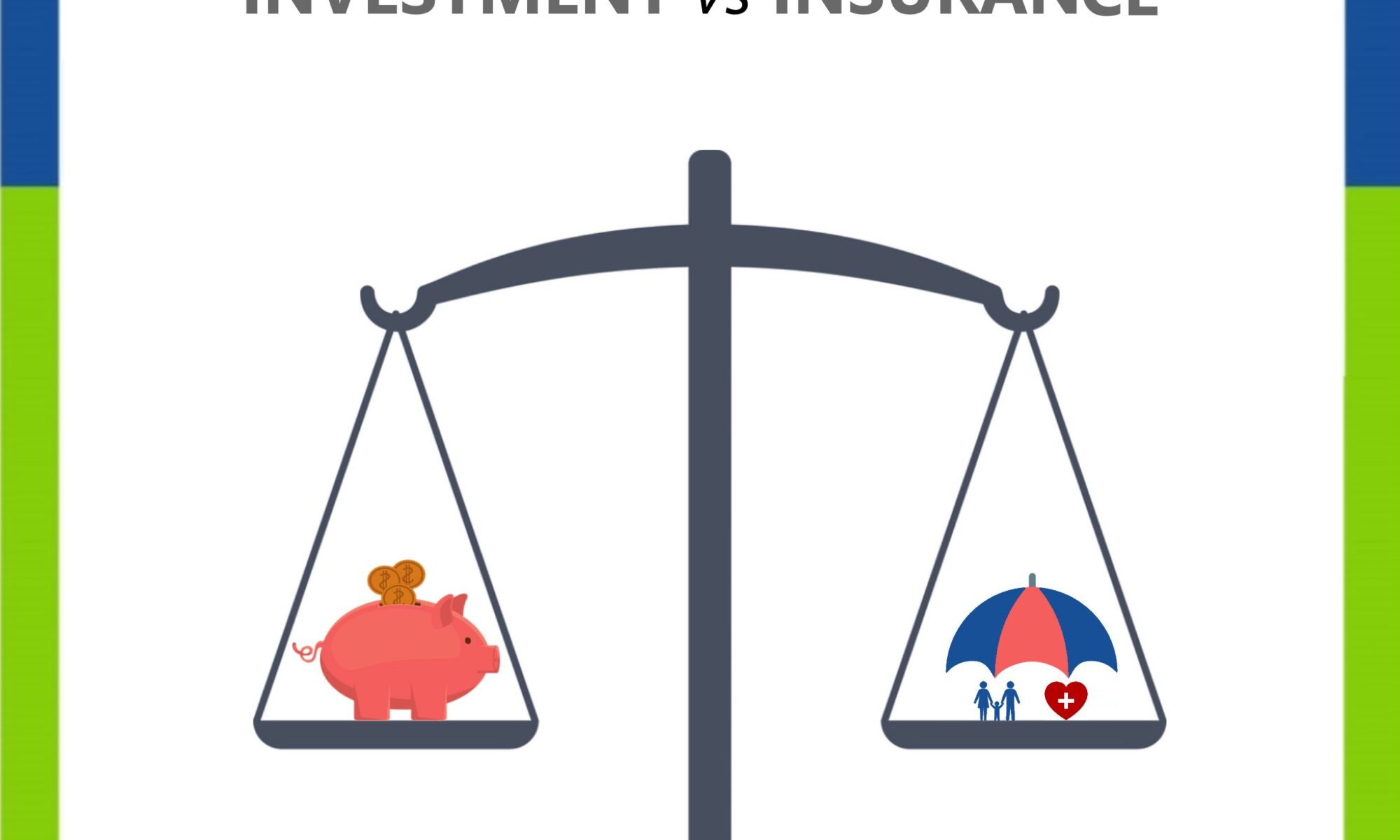
So finally, whether to invest or insure first? So, this is typically a chicken and egg situation – who came first. To put more aptly, here it would be which one to do first, buy insurance, or start investing? Now, the best thing to do is to do both things simultaneously.
For example, let’s suppose Rajeev is a 25-years-old, and given his monthly income of Rs 40,000, he can take out Rs 10,000 each month, i.e. Rs 1.2 lakh annually, for savings/investments/insurance. So what should he do?
Here is how you can allot the money towards insurance and investments
Health insurance: It is a good practice to have at least 6 times your monthly salary as your health insurance coverage. By that logic, since Rajeev’s monthly income is Rs 40,000, his health coverage should be between Rs 2.4 to Rs 2.5 lakh. At the age of 25, the yearly premium amount for Rs 2.5 lakh health insurance would be about Rs 5,000.
Term life insurance: Since Rajeev doesn’t have a lot of liabilities, a term cover of Rs. 1 crore would be enough. Say the term life insurance cover that you need at this stage is Rs 50 lakh. The premium for a Rs 1 crore term policy would be around Rs 8,000 annually.
Investments: The rest of the Rs 1.1 lakh you can invest in Mutual Funds. Since Rajeev is young, he can take risks, and therefore you should invest in equity mutual funds. He can consider large-cap mutual funds or multi-cap funds and start a monthly SIP in these funds.
Now, as and when the income increases, he should also increase your investment amount. Rajeev should also review his health and term cover at regular intervals to ensure the cover is sufficient.